Why Weddings Are Steeped in Luck Rituals
Of all the life events surrounded by superstition, weddings stand alone in their sheer density of luck-related traditions. Nearly every element of a traditional Western wedding — the dress, the veil, the flowers, the food, the direction the bride walks — has roots in beliefs about attracting good fortune or warding off evil. These rituals span centuries and cultures, revealing a deep human need to invoke luck at life's most significant transitions.
What is remarkable is how many of these traditions persist even among people who do not consciously believe in luck. Understanding why they endure tells us as much about human psychology as it does about cultural history.
Something Old, Something New, Something Borrowed, Something Blue
This beloved rhyme originated in Victorian England and dates to at least 1871, when it appeared in print. The full version, now largely forgotten, ends with "and a sixpence in her shoe." Each element was believed to bring a specific type of fortune to the marriage:
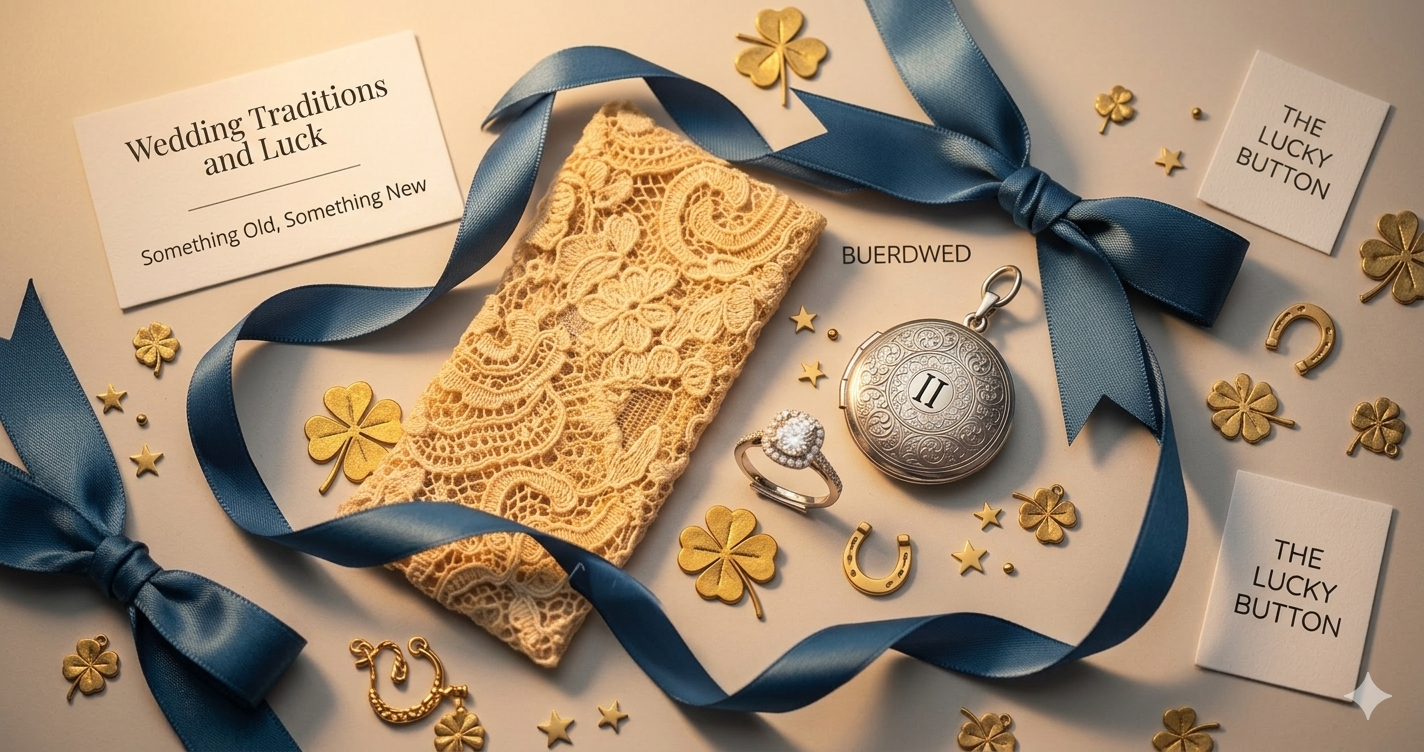
Something old represents continuity with the bride's past and her family. Traditionally, this might be a piece of family jewelry, a grandmother's handkerchief, or a mother's brooch. The psychological function is clear: it ties the new union to the stability and wisdom of established relationships.
Something new symbolizes optimism for the future and the new life the couple is building together. The wedding dress itself often fulfills this role, though it can be any new item — shoes, earrings, or a gift from the groom.
Something borrowed is meant to come from a happily married friend or family member, carrying their good fortune into the new marriage. This tradition reflects a belief in the transferability of luck — that proximity to fortunate people increases your own fortune. Interestingly, modern psychology research on social contagion suggests there is a kernel of truth here: happiness and relationship satisfaction do spread through social networks, as documented by Fowler and Christakis (2008) in their influential study of the Framingham Heart Study social network data.
Something blue symbolizes purity, fidelity, and love. Blue has been associated with the Virgin Mary in Christian traditions and was considered a color of constancy long before it became associated with sadness. In ancient Israel, brides wore blue ribbons in their hair as a sign of fidelity.
A sixpence in her shoe was meant to ensure financial prosperity. A sixpence was a small British coin, and placing it in the left shoe was thought to bring wealth to the couple. Today, some brides substitute a penny or other small coin.
The Wedding Veil: Protection from Evil Spirits
The wedding veil is one of the oldest continuously practiced wedding traditions, dating back to ancient Rome and possibly earlier. Its original purpose was decidedly practical in a supernatural sense: the veil was meant to disguise the bride so that evil spirits and jealous rivals could not identify her and cast curses on the marriage.
In arranged marriages, the veil served an additional function — it prevented the groom from seeing the bride before the ceremony, which was considered extremely bad luck. This tradition persists in many cultures today, even though arranged marriages are less common. The superstition that the groom should not see the bride before the ceremony remains one of the most widely observed wedding customs.
Roman brides wore flame-colored veils called "flammeum" to ward off evil spirits. In some interpretations, the veil also symbolized the bride's purity and modesty. When the groom lifted the veil at the ceremony's conclusion, it symbolized his taking possession — a tradition that modern couples often reinterpret as a moment of revelation and connection.
Throwing Rice, Confetti, and Flower Petals
The practice of showering newlyweds with rice as they leave the ceremony is a fertility ritual that stretches back centuries. Rice, as a staple grain, symbolized abundance, prosperity, and the hope for many children. Similar traditions existed across cultures: in parts of Italy, guests threw sugared almonds; in Morocco, dates and figs; in parts of England, wheat grain.
The shift from rice to confetti, birdseed, or flower petals in recent decades was driven partly by the widespread (though scientifically unsupported) belief that uncooked rice harmed birds who ate it. Ornithologists at Cornell University have debunked this myth, but the alternative traditions have become established in their own right.
The underlying psychology is consistent across all versions: the communal act of showering the couple is a form of social blessing. Participation in a collective ritual strengthens the community's investment in the marriage and the couple's sense of being supported.
Horseshoes: An Iron Shield Against Bad Luck
The tradition of displaying a horseshoe at weddings comes from a broader European belief that horseshoes bring good luck. This belief has several proposed origins. Iron was thought to repel fairies and evil spirits in Celtic traditions. The horseshoe's crescent shape resembled the moon, associated with fertility goddesses. And the blacksmith who forged horseshoes was considered a figure of power and protection.
At weddings, horseshoes were traditionally carried by the bride or given as gifts. In parts of Britain and Ireland, the bride would carry a small decorative horseshoe (often made of porcelain or silver) attached to her bouquet. The horseshoe had to be positioned with the opening facing upward — like a cup — so that the luck would not "spill out."
This tradition has waned in many places but remains common in British and Irish weddings, where small horseshoe charms are still given as wedding favors.
Rain on the Wedding Day
"Happy is the bride that the sun shines on" is a well-known English proverb, but attitudes toward wedding-day rain vary dramatically across cultures.
In many Western traditions, rain on the wedding day is considered bad luck — an ominous start to the marriage. But in Hindu culture, rain on the wedding day is considered extremely auspicious because it represents fertility and cleansing. In Italian tradition, a wet wedding day is also lucky: "Sposa bagnata, sposa fortunata" (a wet bride is a lucky bride).
In some interpretations, rain symbolizes the last tears the bride will cry — meaning the marriage itself will be tear-free. Other cultures view rain as a sign that the couple's union is blessed by heaven.
The variation across cultures is instructive. The rain is the same; the meaning is entirely constructed. This highlights a fundamental truth about luck: much of what we consider lucky or unlucky is a cultural narrative rather than an inherent property of the event.
Wedding Cake: Luck You Can Eat
The modern wedding cake evolved from an ancient Roman tradition of breaking bread over the bride's head — the crumbs were considered lucky, and guests would scramble to collect them. Over centuries, this evolved into stacking sweet buns as high as possible (the couple had to kiss over the tower without toppling it for good luck), and eventually into the tiered cakes we know today.
Saving the top tier of the wedding cake for the first anniversary is another luck tradition. Originally, the top tier was saved for the christening of the first child — a reflection of how quickly children were expected to follow marriage in earlier centuries. As family planning changed, the tradition shifted to the first anniversary.
In some traditions, single women placed a piece of wedding cake under their pillow to dream of their future spouse. This practice was common enough in 19th-century England that specialized small cake boxes were created for guests to take home a "dream piece."
Modern Psychology: Why Rituals Still Matter
Contemporary psychological research suggests that wedding luck rituals persist not because people literally believe in evil spirits or fertility magic, but because rituals serve genuine psychological functions.
Research by Francesca Gino and Michael Norton (2013) at Harvard Business School demonstrated that rituals reduce anxiety and increase feelings of control, even when participants acknowledged the rituals were arbitrary. In their experiments, people who performed simple rituals before stressful tasks showed lower heart rates, reported less anxiety, and performed better.
Applied to weddings, this means that the "something old, something new" checklist, the careful avoidance of the groom seeing the dress, and the horseshoe on the bouquet all serve to reduce wedding-day anxiety and create a sense that everything possible has been done to ensure a happy outcome.
Anthropologist Victor Turner argued that rituals create "liminal spaces" — thresholds between one state of being and another. Wedding luck rituals help couples and their communities navigate the profound transition from two single lives to one shared life. The specific content of the ritual matters less than the fact that a ritual exists.
In this light, wedding luck traditions are neither irrational nor outdated. They are sophisticated psychological tools, refined over centuries, for managing uncertainty at life's most significant moments. Whether you carry a horseshoe or skip the veil entirely, the impulse to mark a wedding with acts of hopeful intention is deeply, beautifully human.
📚 References & Further Reading
- Connected: The Surprising Power of Our Social Networks and How They Shape Our Lives — Christakis, N. A., & Fowler, J. H. (2009)
- Rituals Alleviate Grieving for Loved Ones, Lovers, and Lotteries — Norton, M. I., & Gino, F. (2014)
- The Ritual Process: Structure and Anti-Structure — Turner, V. (1969)
- Curious Customs: The Stories Behind 296 Popular American Rituals — Tuleja, T. (1987)
Lucky Button Team
Educators & Probability Researchers
A multidisciplinary team of psychology graduates, data scientists, and educators dedicated to making the science of luck accessible and fun.
Learn more about our team →Join the Conversation
Tell Us: What does luck mean to you?
Loading comments...