The Game Show Puzzle That Stumped Thousands of Mathematicians
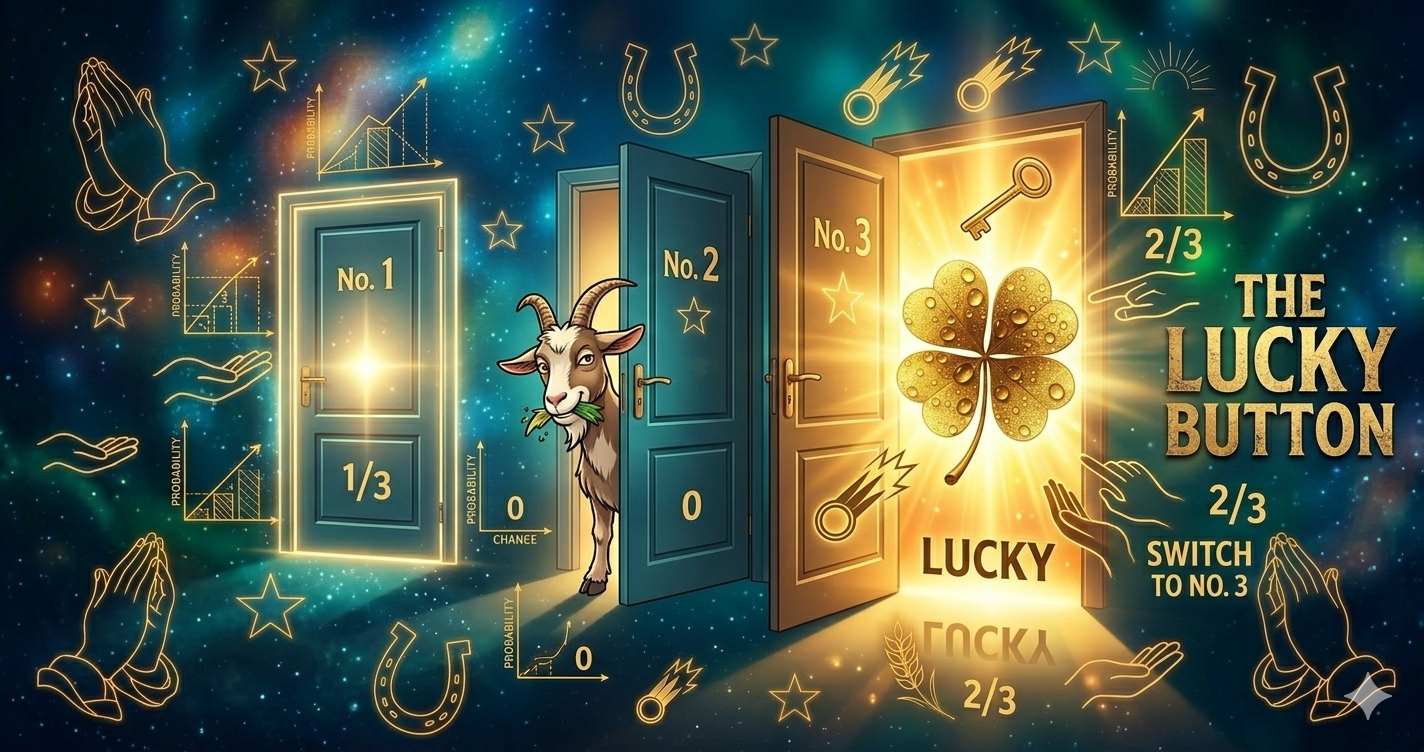
Imagine you are on a game show. The host, Monty Hall, presents you with three closed doors. Behind one door is a brand-new car. Behind the other two are goats. You pick a door — say, Door #1. Monty, who knows what is behind every door, opens another door — say, Door #3 — revealing a goat. He then asks you: "Do you want to switch to Door #2?"
Should you switch? Most people say it does not matter. Their gut tells them it is a 50/50 shot either way. But mathematics tells a very different story — and it is one of the most elegant demonstrations of why human intuition about probability is deeply flawed.
The correct answer: you should always switch. Switching gives you a 2/3 chance of winning, while staying gives you only a 1/3 chance. This result has baffled amateurs and professionals alike for decades, and understanding why it works reveals profound insights about how luck, probability, and information interact.
The Marilyn vos Savant Controversy
The Monty Hall problem became a cultural phenomenon in 1990 when Marilyn vos Savant — listed in the Guinness Book of World Records for the highest recorded IQ — answered the question in her "Ask Marilyn" column in Parade magazine. She correctly stated that you should always switch doors.
The backlash was extraordinary. Approximately 10,000 readers wrote in to tell her she was wrong, including nearly 1,000 people with PhDs. Paul Erdos, one of the most prolific mathematicians in history, reportedly refused to believe the answer until he was shown a computer simulation. Letters poured in from university professors calling her reasoning "clearly wrong" and accusing her of setting back public understanding of mathematics.
She was right. They were wrong. The episode remains one of the most striking examples of how poorly even trained minds handle conditional probability.
Why Switching Works: The Bayesian Explanation
To understand the solution, you need to think carefully about what information Monty's action gives you.
Step 1: Your initial pick. When you first choose a door, you have a 1/3 chance of picking the car and a 2/3 chance of picking a goat. This is straightforward.
Step 2: Monty opens a door. Here is the crucial insight — Monty is not opening a door at random. He always opens a door with a goat behind it, and he never opens the door you selected. This constrained action changes the probability landscape.
Step 3: The probability shift. If you initially picked the car (1/3 probability), switching loses. If you initially picked a goat (2/3 probability), switching wins — because Monty has already eliminated the other goat for you. Since you pick a goat 2/3 of the time, switching wins 2/3 of the time.
In Bayesian terms, Monty's action updates our prior probabilities. Before he opens a door, each unchosen door has a 1/3 chance of hiding the car. After he opens a door (always revealing a goat), the entire 2/3 probability that was spread across the two unchosen doors collapses onto the single remaining unchosen door. The door you picked retains its original 1/3 probability because Monty's action was constrained to never reveal the car to you.
Scaling Up: The 100-Door Version
If the three-door version still feels counterintuitive, consider a version with 100 doors. You pick one door. Monty then opens 98 doors, all revealing goats, leaving just your door and one other door closed. Would you switch now?
Most people immediately see the logic here. Your initial pick had a 1/100 chance of being correct. The remaining door effectively holds the combined probability of the other 99 doors — a 99/100 chance. Of course you should switch.
The three-door version works on exactly the same principle. The numbers are just less dramatic, which is why our intuition struggles.
Experimental Verification
The Monty Hall solution is not just a theoretical curiosity — it has been verified experimentally many times.
In a landmark study published in the Journal of Behavioral Decision Making, researchers Friedman (1998) had participants play hundreds of rounds of the Monty Hall game. Those who switched won approximately 66% of the time, perfectly matching the predicted 2/3 probability. Those who stuck with their initial choice won about 33% of the time.
Pigeons, fascinatingly, learn to switch doors faster than humans do. A 2010 study by Herbranson and Schroeder published in the Journal of Comparative Psychology found that pigeons converged on the optimal switching strategy within 30 trials, while most human participants continued to split their choices roughly evenly even after extensive experience. The researchers suggested that humans are hampered by a mistaken belief in equal probability that pigeons simply do not have.
Why Our Intuition Fails
Several cognitive biases conspire to make the Monty Hall problem feel wrong even when we know the math:
The equiprobability bias leads people to assume that when there are two remaining options, each must have a 50% chance. This feels natural but ignores the asymmetric information in the problem.
Status quo bias makes people reluctant to switch away from their initial choice. We tend to feel that an error of omission (not switching and losing) is less painful than an error of commission (switching and losing), even when the expected outcomes differ.
The illusion of control gives people an inflated sense of the quality of their initial choice. Having actively selected Door #1, they feel a psychological ownership that makes it harder to abandon.
Failure to update on new information is perhaps the deepest issue. Monty's action provides genuine new information, but people treat it as irrelevant because they focus on the number of remaining doors rather than the constrained process that produced the reveal.
Real-World Applications
The logic behind the Monty Hall problem extends far beyond game shows. Conditional probability and Bayesian updating are fundamental to:
- Medical diagnosis: When a screening test comes back positive, the probability that you actually have the disease depends on the base rate — just as the probability of each door depends on the prior information. Many doctors struggle with this, leading to unnecessary anxiety and over-treatment.
- Legal reasoning: DNA evidence, eyewitness testimony, and forensic analysis all require careful Bayesian reasoning. The "prosecutor's fallacy" — confusing the probability of evidence given innocence with the probability of innocence given evidence — is structurally similar to the Monty Hall error.
- Investment decisions: New market information should update your beliefs about an investment, but many investors either ignore new information (staying with their pick) or overreact to it.
- Scientific research: Updating hypotheses based on experimental evidence is the foundation of the scientific method. The Monty Hall problem illustrates how difficult this updating process is, even for trained scientists.
The Luck Lesson
The Monty Hall problem teaches us something profound about luck. What feels like luck — picking the right door — is often the result of understanding how information changes probabilities. The "lucky" choice is the informed choice.
People who understand conditional probability can make decisions that systematically improve their outcomes. They update their beliefs when new information arrives rather than clinging to initial impressions. They recognize that the process by which information is revealed matters as much as the information itself.
In everyday life, this means paying attention to how situations unfold and being willing to change course when the evidence suggests you should. The luckiest people are not those who pick the right door on the first try — they are the ones who know when to switch.
📚 References & Further Reading
- The Monty Hall Dilemma Revisited: Understanding the Interaction of Problem Definition and Decision Making — Friedman, D. (1998)
- Are birds smarter than mathematicians? Pigeons (Columba livia) perform optimally on a version of the Monty Hall Dilemma — Herbranson, W. T., & Schroeder, J. (2010)
- The Drunkard's Walk: How Randomness Rules Our Lives — Mlodinow, L. (2008)
- Ask Marilyn Column — The Monty Hall Problem — vos Savant, M. (1990)
Lucky Button Team
Educators & Probability Researchers
A multidisciplinary team of psychology graduates, data scientists, and educators dedicated to making the science of luck accessible and fun.
Learn more about our team →Join the Conversation
Tell Us: What does luck mean to you?
Loading comments...