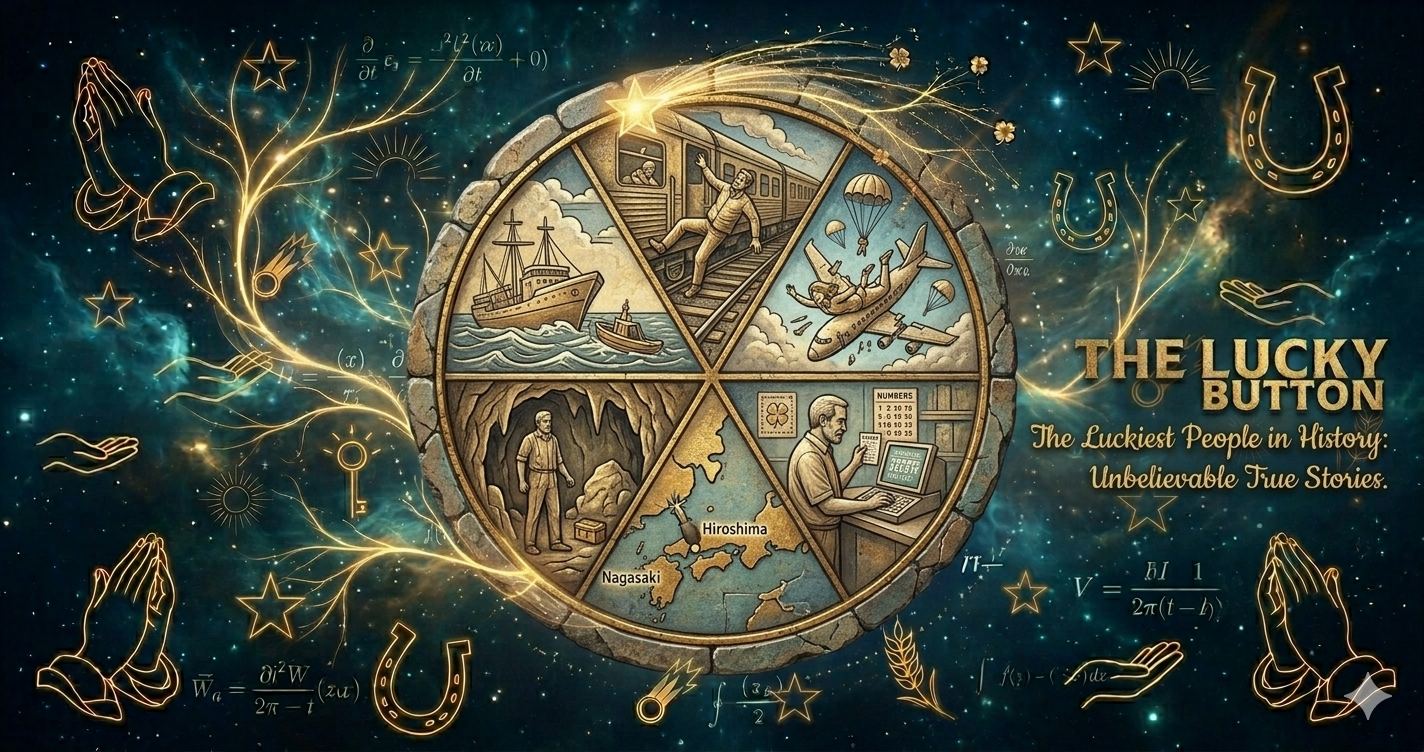
The People Fortune Refused to Forget
History is filled with individuals whose lives seem to defy the very laws of probability. Their stories are not legends or tall tales -- they are documented, verified accounts that force us to confront an uncomfortable question: is extraordinary luck purely random, or is something deeper at work?
These are the stories of people who survived the unsurvivable, won the unwinnable, and walked away from events that should have ended them. Each one is real. Each one is extraordinary.
---
Frano Selak: The Man Who Cheated Death Seven Times
Croatian music teacher Frano Selak earned the title "the world's luckiest -- or unluckiest -- man" through a series of near-death experiences spanning four decades that would strain the credulity of any Hollywood screenwriter.
The timeline of survival:
- 1962: A train he was riding derailed and plunged into an icy river. Seventeen passengers drowned. Selak swam to shore with a broken arm and hypothermia.
- 1963: On his first and only plane flight, the rear door blew open mid-flight. Selak was sucked out of the aircraft but landed in a haystack. Nineteen others died in the crash.
- 1966: A bus he was traveling on skidded off a road into a river. Four passengers drowned. Selak swam to safety with minor cuts.
- 1970: His car caught fire while driving. He managed to escape moments before the fuel tank exploded.
- 1973: Another car fire -- this time the engine malfunctioned, sending flames through the air vents. He lost most of his hair but survived.
- 1995: He was hit by a city bus in Zagreb but walked away with minor injuries.
- 1996: While driving on a mountain road, he swerved to avoid an oncoming truck, crashed through a guardrail, and was ejected from the car. He grabbed a tree branch and watched his vehicle explode 300 feet below.
Then, in 2003, Selak won 800,000 British pounds in the Croatian lottery. He reportedly gave most of the money away, saying he had already received the greatest fortune of all: his life. Selak passed away peacefully in 2016 at the age of 87.
The probability of surviving even two of these events is vanishingly small. Surviving all seven, followed by a major lottery win, occupies a statistical space so improbable that mathematicians struggle to express it meaningfully.
---
Tsutomu Yamaguchi: Survivor of Two Atomic Bombs
On August 6, 1945, Tsutomu Yamaguchi was in Hiroshima on a business trip for Mitsubishi Heavy Industries when the United States dropped the first atomic bomb. He was approximately three kilometers from ground zero. The blast ruptured his eardrums, temporarily blinded him, and left him with severe burns across his upper body.
After receiving treatment, Yamaguchi did something remarkable: he returned to his hometown. His hometown was Nagasaki.
Three days later, on August 9, the second atomic bomb fell. Yamaguchi was in his employer's office, describing the horror of Hiroshima to his supervisor, when the sky turned white again. Once more, he was roughly three kilometers from the blast center. Once more, he survived.
Yamaguchi was officially recognized by the Japanese government in 2009 as a nijuu hibakusha -- a double atomic bomb survivor. While approximately 165 people are believed to have been present in both cities during the bombings, Yamaguchi was the only person formally acknowledged by both the Japanese and international communities.
He lived until January 4, 2010, passing away at the age of 93. He spent his later years as an outspoken advocate for nuclear disarmament, turning his impossible survival into a platform for peace.
The odds of surviving one nuclear detonation at close range were already extraordinarily low. Surviving two, separated by just 72 hours and 300 kilometers, places Yamaguchi in a category of fortune that is effectively without parallel in recorded human history.
---
Joan Ginther: The Woman Who Won the Lottery Four Times
Joan Ginther, a former Stanford University statistics professor from Bishop, Texas, won major lottery prizes not once, not twice, but four times between 1993 and 2010:
- 1993: $5.4 million from Lotto Texas
- 2006: $2 million from a scratch-off ticket purchased at the Times Market in Bishop
- 2008: $3 million from another scratch-off at the same store
- 2010: $10 million from yet another scratch-off, again at the same store
The total: $20.4 million in winnings. Nathaniel Rich, writing for Harper's Magazine, calculated the odds of one person winning four top lottery prizes at approximately 1 in 18 septillion (18 followed by 24 zeros).
However, statisticians have offered more nuanced analyses. Dr. Skip Garibaldi of Emory University and the Institute for Pure and Applied Mathematics noted that if Ginther purchased lottery tickets in very high volume -- which her spending patterns suggested -- the odds, while still astronomical, become somewhat less impossible. Her background in statistics has fueled speculation that she may have identified vulnerabilities in the Texas scratch-off distribution system, though this has never been proven and the Texas Lottery Commission found no evidence of fraud.
Ginther's story illustrates a fascinating tension between pure luck and the possibility that deep mathematical knowledge can shift probability in one's favor -- a theme that recurs throughout the history of fortune.
---
Roy Sullivan: The Human Lightning Rod
Roy Sullivan, a park ranger in Shenandoah National Park, Virginia, holds the Guinness World Record for being struck by lightning more times than any other human being: seven times between 1942 and 1977, each documented by park superintendents and medical records.
His strikes:
1. 1942: Struck in a fire lookout tower. Lost a big toenail.
2. 1969: Struck while driving on a mountain road. Lost his eyebrows.
3. 1970: Struck in his front yard. Left shoulder seared.
4. 1972: Struck inside a ranger station. Hair set on fire.
5. 1973: Struck while in his car during patrol. Hair set on fire again; legs seared.
6. 1976: Struck while checking on a campground. Ankle injured.
7. 1977: Struck while fishing. Hospitalized for chest and stomach burns.
The odds of being struck by lightning once in a given year are roughly 1 in 1,222,000 according to the National Weather Service. The probability of being struck seven times over a 35-year period is estimated at approximately 1 in 10 to the 28th power -- a number so large it approaches the realm of physical impossibility.
However, context matters enormously. Sullivan spent most of his working life outdoors in mountainous terrain during thunderstorm-prone months. His occupational exposure dramatically increased his base probability compared to the average person. Some statisticians have estimated that for someone with Sullivan's specific outdoor exposure pattern, the odds of multiple strikes, while still extremely unlikely, drop to a range that is at least calculable.
---
What Can We Learn from History's Luckiest People?
These stories share several common threads that are worth examining:
Survival is not passive. In almost every case, the lucky individual took action -- swimming to shore, grabbing a tree branch, seeking medical treatment, returning to work. Fortune favored them, but they also met fortune halfway through resilience and determination.
Context shapes probability. Roy Sullivan's seven lightning strikes seem more comprehensible when we account for his occupational exposure. Joan Ginther's four lottery wins become slightly less mystifying if she was purchasing thousands of tickets using statistical analysis. Pure randomness is only part of the story; the environment in which randomness operates matters immensely.
The narrative fallacy is powerful. Our brains are wired to create stories from random events. We remember Frano Selak because his seven escapes form a compelling arc. We do not remember the thousands of people who survived one unusual event and then lived ordinary lives. Survivorship bias shapes which stories reach us and how we interpret them.
Probability does not mean impossibility. In a world of eight billion people, events with one-in-a-billion odds should happen roughly eight times. The existence of extraordinarily lucky individuals is not just possible -- it is mathematically expected. As mathematician Persi Diaconis has noted, the truly unlikely outcome would be if no one ever experienced these kinds of improbable event clusters.
These individuals remind us that the boundary between the possible and the impossible is far more porous than our intuitions suggest. Their stories are not evidence of supernatural forces. They are evidence that in a vast and complex world, the improbable is not only possible -- it is inevitable.
📚 References & Further Reading
- Frano Selak: The World's Luckiest Man — The Telegraph (2003)
- Tsutomu Yamaguchi: Double A-Bomb Survivor — BBC News (2009)
- Joan Ginther: The Luckiest Woman on Earth — Nathaniel Rich, Harper's Magazine (2011)
- Lightning Injuries and Deaths — National Weather Service (2023)
- The Improbability Principle — David J. Hand (2014)
Lucky Button Team
Educators & Probability Researchers
A multidisciplinary team of psychology graduates, data scientists, and educators dedicated to making the science of luck accessible and fun.
Learn more about our team →Join the Conversation
Tell Us: What does luck mean to you?
Loading comments...