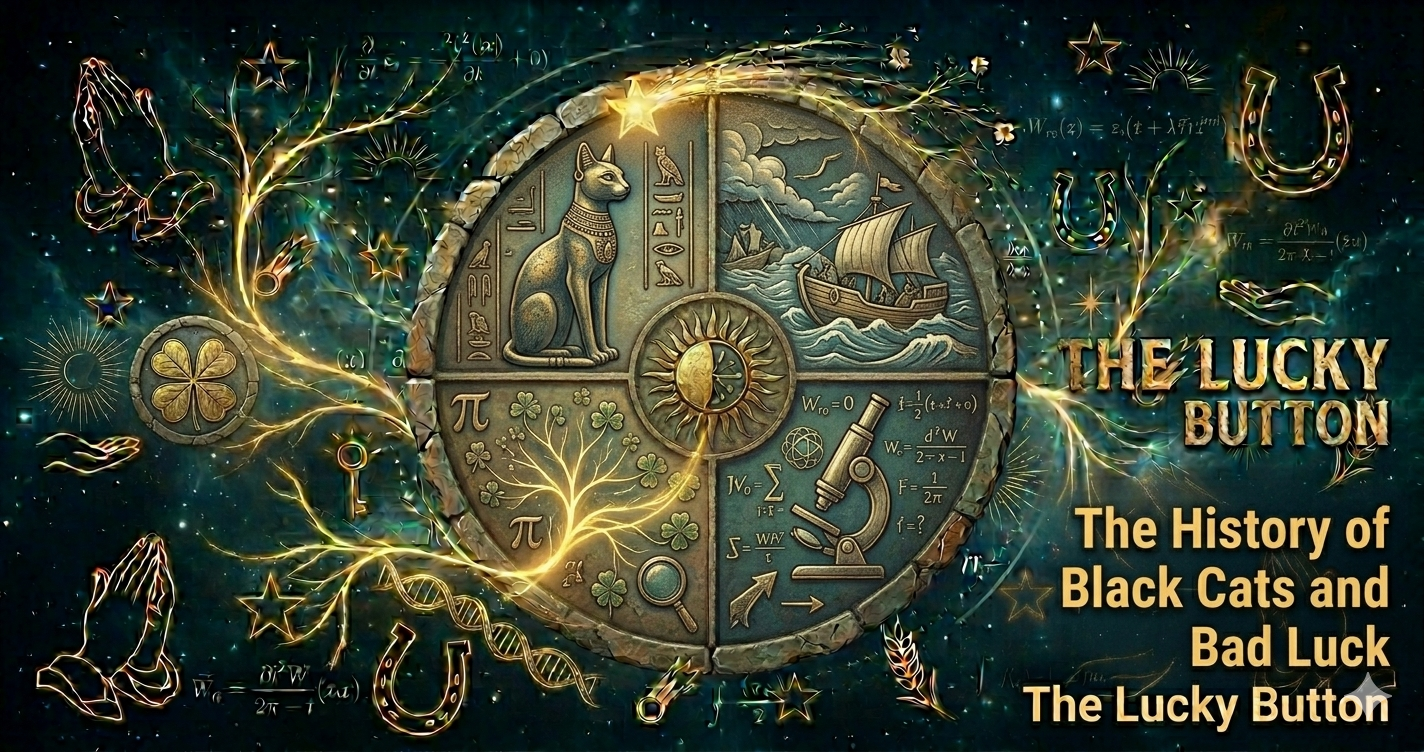
Lucky Button

Press For Instant Silliness!

The History of Black Cats and Bad Luck: How One Superstition Took Over the World

By Lucky Button September 21, 2025


You see a black cat cross your path and automatically think “bad luck.” But why? This simple belief has caused centuries of fear, hurt millions of innocent cats, and spread across every continent. The real story behind how black cats became symbols of misfortune is way more interesting than you think.

Picture this: you’re walking down the street and a black cat runs in front of you. What’s your first thought? If you’re like most people, the words “bad luck” probably pop into your head. Even if you don’t really believe it, the idea is still there.

But here’s the crazy part. This belief has been around for hundreds of years. It’s traveled across oceans, survived wars, and somehow convinced people in completely different cultures that these beautiful animals are somehow dangerous.

How did one simple superstition become so powerful? And why do millions of people still believe it today, even when they know it doesn’t make logical sense?

The answer takes us on a journey through ancient Egypt, medieval Europe, and right up to your local animal shelter where black cats wait longer than any other cats to find homes.

Why Black Cats Got a Bad Reputation

The black cat superstition didn’t start overnight. It built up slowly over centuries, like a snowball rolling down a hill, picking up more fears and stories along the way.

The Fear of Black

Color Psychology: Humans have always associated black with darkness, death, and the unknown

Natural Fear: Black cats are harder to see at night, making them seem mysterious and unpredictable

Religious Influence: Many religions connected darkness with evil spirits and bad forces

Think about it from a practical standpoint. If you lived 500 years ago and had no electric lights, darkness was genuinely scary. Dangerous animals hunted at night. People got lost and hurt when they couldn’t see. So anything that reminded people of darkness automatically felt threatening.

Black cats, being naturally dark colored, got caught up in this fear. They move silently, their eyes glow in the dark, and they’re active at night when people are sleeping. To someone who didn’t understand animal behavior, this probably seemed pretty spooky.

But the color thing alone wasn’t enough to create such a lasting superstition. Something much bigger had to happen to turn these cats from mysterious to downright dangerous in people’s minds.

Ancient Times: When Black Cats Were Actually Lucky

Here’s what might surprise you: black cats weren’t always considered unlucky. In fact, for thousands of years, they were seen as some of the luckiest animals on earth.

Ancient Egypt: Cat Worship Central

In ancient Egypt, all cats were sacred animals, but black cats were extra special. They were connected to Bastet, the goddess of protection, fertility, and motherhood.

Egyptian families believed that having a black cat in their house would bring them good fortune and keep evil spirits away. When cats died, families would mummify them and mourn for months.

The Egyptians weren’t alone in loving black cats. Ancient Romans thought black cats could predict the future. Greek sailors believed that having a black cat on their ship would guarantee a safe journey home.

In many Celtic cultures, black cats were considered magical creatures that could bring wealth and happiness to their owners. Some people even believed that black cats could grant wishes.

So what changed? How did these beloved, lucky animals become symbols of bad fortune? The answer lies in one of the darkest periods of European history.

The Medieval Period: When Everything Went Wrong

Around 1000 AD, Europe entered what we now call the Medieval period. Life was hard, people were scared, and the Christian church was becoming more powerful every day. This was when everything started to go downhill for black cats.

The Church Takes Control

New Religious Rules: The Catholic Church wanted to get rid of all “pagan” beliefs and traditions

Fear of Witchcraft: Church leaders taught that magic and witchcraft were real and dangerous

Devil Associations: Black color became linked with Satan and evil spirits

Animal Suspicion: Any animal that seemed “different” or “mysterious” was viewed with suspicion

The church had a problem. People still remembered the old religions where animals were worshipped and magic was considered normal. To build their power, church leaders needed people to forget these old ways and follow Christian rules instead.

Black cats became easy targets. They were already mysterious because of their color and nighttime habits. Plus, many people still believed cats had magical powers from the old religions. Church leaders decided that if cats were magical, and magic was evil, then cats must be evil too.

This wasn’t just about cats, though. The church was trying to control how people thought about everything. They wanted people to believe that anything unusual or unexplained was probably dangerous.

But the real disaster for black cats happened when the witch trials started.

Witches and Black Cats: The Deadly Connection

Between 1450 and 1750, Europe and North America went through what historians call the “witch craze.” During this time, thousands of people (mostly women) were accused of being witches and killed.

And black cats got caught right in the middle of it.

The Witch Trial Logic

The Belief: Witches had “familiars” – magical animal helpers that did evil work

The Evidence: Any woman who lived alone with cats was automatically suspicious

The Outcome: Both the women and their cats were often killed together

The Reality: Most of these women were just poor, elderly, or different from their neighbors

Church and government officials taught people that witches used black cats to cast spells, deliver curses, and communicate with the devil. They claimed that black cats were actually demons in disguise, or that witches could turn themselves into black cats to sneak around at night.

This created a terrible cycle. Women who lived alone often kept cats for companionship and to catch mice. But having cats, especially black ones, made them look like witches to their neighbors. So the very thing that brought them comfort also put them in deadly danger.

The fear got so bad that some towns would round up and kill all their black cats during certain times of the year. People believed this would protect them from witchcraft and bad luck.

Of course, killing all the cats actually did bring bad luck. With no cats around to hunt them, rat populations exploded. More rats meant more disease, which made people sicker and more miserable. But instead of realizing their mistake, people just became more convinced that black cats were cursed.

How the Superstition Spread Around the World

You might think that the black cat superstition stayed in Europe where it started. But you’d be wrong. As Europeans explored and colonized other parts of the world, they brought their fears and beliefs with them.

Global Spread Timeline

1500s-1600s: Spanish and Portuguese colonizers bring the superstition to South America

1600s-1700s: English and Dutch settlers carry the belief to North America and Asia

1700s-1800s: European missionaries spread the superstition to Africa and the Pacific islands

1800s-1900s: Trade and communication help the belief reach even remote areas

But here’s what’s interesting: the superstition didn’t take hold everywhere in the same way. In places where local cultures already had strong positive beliefs about cats, the European superstition had to compete with older traditions.

For example, in Japan, black cats were already considered symbols of good luck and prosperity. Japanese culture was strong enough that the European belief never completely took over. Even today, many Japanese people still see black cats as fortunate.

In some parts of Africa, cats were associated with wisdom and protection. Local beliefs about cats being guardians against evil spirits were stronger than the European ideas about cats being evil.

But in places where European colonizers had more control over local culture, the superstition spread quickly. This is why countries like the United States, Canada, and Australia still have strong black cat superstitions today.

Different Cultures, Different Beliefs

Not every culture around the world believes black cats are unlucky. In fact, the differences are pretty amazing when you look at them side by side.

Lucky Black Cats Around the World

Scotland: A black cat appearing on your doorstep means prosperity is coming

Japan: Black cats bring good luck, especially for single women looking for love

England: Black cats are wedding gifts that bring happiness to the marriage

Ireland: A black cat crossing your path in moonlight means good fortune

Germany: It depends on which direction the cat crosses – left to right is lucky!

These cultural differences show us something important: the idea that black cats are unlucky isn’t some universal truth. It’s just one belief system that happened to spread widely because of historical events.

In some cultures, the same exact event (a black cat crossing your path) means completely opposite things depending on where you live. This proves that the superstition is learned, not natural.

But even in cultures where black cats are considered lucky, the European superstition has started to creep in through movies, books, and internet culture. Global communication is slowly spreading the “unlucky” belief to places that never had it before.

The Real Cost of This Superstition

You might think that believing black cats are unlucky is just harmless fun. But this superstition has real consequences that affect animals and people even today.

Modern Impact on Black Cats

Adoption Rates: Black cats stay in shelters 50% longer than other colored cats

Euthanization: Black cats are more likely to be put down due to lack of adoption

Halloween Harm: Some shelters won’t adopt black cats in October due to abuse fears

Breeding Issues: Some breeders report lower demand for black kittens

Abandonment: Black cats are abandoned more often when people’s circumstances change

Animal shelters across the United States report that black cats are consistently the hardest to place in homes. Potential pet owners pass them by, often without even realizing why. The superstition has become so deeply embedded in our culture that people feel uneasy about black cats even when they don’t consciously believe in bad luck.

This is especially sad because black cats make just as wonderful pets as any other cats. Their color has absolutely nothing to do with their personality, health, or behavior. A black cat is just as likely to be friendly, playful, and loving as a white, orange, or striped cat.

The superstition also affects how people treat black cats they encounter outside. Some people will cross the street to avoid them, chase them away from their property, or even hurt them because they believe the cats are bringing bad luck.

During Halloween, the problem gets worse. Some people associate black cats so strongly with witches and evil that they see them as Halloween decorations rather than living animals that deserve care and respect.

Modern Times: Why People Still Believe

We live in an age of science and technology. We understand genetics, animal behavior, and probability. So why do millions of people still believe that black cats bring bad luck?

Why Superstitions Stick Around

Cultural Learning: Kids learn superstitions from parents and friends before they develop critical thinking

Confirmation Bias: People notice when bad things happen after seeing a black cat, but ignore the times when nothing happens

Social Pressure: Even non-believers sometimes act superstitious to fit in with others

Media Reinforcement: Movies, books, and TV shows keep showing black cats as spooky or magical

Safety Mechanism: Some people think “better safe than sorry” even if they doubt the superstition

There’s also something called the “availability heuristic” that keeps superstitions alive. This means people judge how likely something is based on how easily they can remember examples of it happening.

If you’ve seen dozens of movies where black cats are associated with witches, magic, or bad events, those images stay in your mind. Even if you know movies aren’t real, the connection between black cats and scary things feels familiar and believable.

Plus, our brains are naturally good at finding patterns, even when they don’t exist. If someone sees a black cat on Monday and then gets in a fender-bender on Tuesday, their brain might connect these two events even though they have nothing to do with each other.

This connects to research on why people believe bad things happen in patterns. Our minds love to find explanations for random events, and superstitions provide easy answers.

How Movies and Media Keep the Myth Alive

Turn on almost any Halloween movie and you’ll probably see a black cat somewhere in the scary scenes. Open a children’s book about witches and there’s likely a black cat sitting on a broomstick. This constant association in media keeps the superstition alive in ways that most people don’t even notice.

Black Cats in Popular Culture

Horror Movies: Black cats often appear right before something bad happens to the main character

Halloween Decorations: Black cats are standard symbols of spookiness and fear

Witch Stories: From fairy tales to modern novels, witches almost always have black cat companions

Cartoon Portrayals: Even kids’ shows often show black cats as mischievous or magical

Advertising: Companies use black cat imagery to suggest mystery, magic, or danger

This constant media presence does something interesting to our brains. Even people who don’t believe in superstitions start to associate black cats with spookiness just because they’ve seen that connection so many times.

It’s like how you might feel uneasy walking through a dark alley at night, even if you know you’re probably perfectly safe. Your brain has learned from movies and stories that dark alleys are dangerous places, so you feel nervous even when logic tells you otherwise.

The same thing happens with black cats. People who have never had a bad experience with a black cat still feel a little uncomfortable around them because of all the scary movies and stories they’ve absorbed over the years.

But some modern media is starting to fight back against this stereotype. Cat rescue organizations use social media to show black cats being cute, playful, and lovable. Some movies and TV shows feature black cats as heroes or beloved pets rather than scary creatures.

The Science Behind Superstitious Thinking

Scientists have spent a lot of time studying why humans are so prone to superstitious thinking. And what they’ve found explains a lot about why the black cat belief has been so persistent.

How Our Brains Create Superstitions

Pattern Recognition: Human brains evolved to find patterns quickly, even when patterns don’t exist

Loss Aversion: We’re more motivated to avoid bad things than to gain good things

Control Illusion: Superstitions make people feel like they have some control over random events

Social Learning: We copy behaviors and beliefs from people around us without questioning them

Emotional Memory: Scary or emotional experiences stick in our memory better than ordinary ones

Here’s how it works with black cats specifically. Imagine you see a black cat on your way to an important job interview. Later that day, you don’t get the job. Your brain might connect these two events, even though the cat had nothing to do with your interview performance.

But here’s the key part: you’re much more likely to remember this “black cat equals bad luck” connection than you are to remember all the times you saw black cats and nothing bad happened afterward. This is because our brains pay more attention to negative events than positive ones.

Over time, you build up a collection of memories where seeing black cats was followed by bad things, but you forget about all the neutral times. This makes the superstition feel more real and believable than it actually is.

Understanding this process helps explain why superstitions about how our minds create feelings of luck and unluck can feel so convincing even when they’re not based on facts.

Black Cats Today: Fighting Back Against Prejudice

The good news is that many people and organizations are working hard to change how we think about black cats. Animal shelters, veterinarians, and cat lovers around the world are fighting back against centuries of unfair treatment.

Test Your Black Cat Knowledge

How much do you really know about black cat superstitions around the world? Take our quiz to discover surprising facts about how different cultures view these beautiful animals!

Take the Black Cat Quiz

Many shelters now have special programs to help black cats find homes. Some offer adoption discounts for black cats. Others organize “Black Cat Beauty Contest” events to show off how gorgeous these animals can be.

Social media has become a powerful tool for changing minds. Instagram and TikTok are full of accounts dedicated to black cats being adorable, funny, and loving. These accounts show millions of people that black cats are just normal pets who deserve love and care.

Some cities have even started celebrating “Black Cat Appreciation Day” to combat negative stereotypes. These events educate people about the history of anti-black cat prejudice and encourage adoptions.

The change is happening slowly, but it’s definitely happening. Younger generations, who grew up with more access to information and scientific thinking, are less likely to believe in black cat superstitions than their parents and grandparents.

But we still have a long way to go. As long as the superstition exists in popular culture and family traditions, black cats will continue to face unfair treatment.

What This Means for Your Daily Life

Understanding the history behind the black cat superstition can change how you think about lots of other beliefs and assumptions in your life.

Lessons from Black Cat History

Question Your Assumptions: Just because everyone believes something doesn’t make it true

Learn the History: Many of our “common sense” beliefs have surprising historical origins

Think About Consequences: Even “harmless” superstitions can have real effects on people and animals

Be Open to Change: Beliefs that seemed permanent for centuries can shift when people start thinking differently

Consider Multiple Perspectives: Different cultures often have completely different explanations for the same things

The black cat story shows us how powerful cultural beliefs can be, even when they’re not based on facts. It also shows us that these beliefs can change when people decide to think more carefully about them.

If you’ve ever automatically felt nervous around a black cat, now you know why. It’s not because you’re silly or superstitious. It’s because you’ve absorbed centuries of cultural programming that taught you to associate black cats with danger.

But now that you understand where this feeling comes from, you can choose what to do with that knowledge. You can decide whether you want to keep following a belief system that started during witch trials, or whether you want to judge cats based on their actual behavior rather than their color.

This connects to other research about how historical superstitions continue to affect modern thinking in ways we don’t always recognize.

Breaking Free from Inherited Fears

The story of black cats teaches us something important about how we inherit fears and beliefs from previous generations without even realizing it.

Your great-great-grandmother might have been genuinely scared of black cats because she grew up during a time when people really believed in witchcraft. Your great-grandmother absorbed some of that fear, even if she didn’t fully believe in witches. Your grandmother might have felt just a little nervous around black cats without knowing why. Your parents picked up a hint of that nervousness and passed it on to you.

“The most dangerous phrase in the language is ‘We’ve always done it this way.'” – Grace Hopper, computer programmer

This is how superstitions work. They get passed down through families and communities like inherited traits, but unlike eye color or height, beliefs can be changed if we decide to examine them.

The black cat superstition survived for so long because each generation accepted it without questioning where it came from or whether it made sense. People just assumed that if their parents and grandparents believed it, it must be true.

But when we actually look at the history and science behind these beliefs, we often find that they started for reasons that no longer apply to our modern world.

Breaking free from inherited fears isn’t just about black cats. It’s about learning to think independently about all the beliefs and assumptions we’ve absorbed from our culture.

The Future of Black Cat Superstitions

So what happens next? Will people still believe black cats are unlucky a hundred years from now?

Signs of Change

Education: More people understand the historical origins of superstitions

Science: Better education about animal behavior and genetics

Global Communication: People learn about different cultural beliefs from around the world

Animal Welfare: Growing awareness of how superstitions affect real animals

Individual Thinking: More emphasis on making personal decisions based on evidence rather than tradition

The superstition probably won’t disappear completely anytime soon. Cultural beliefs that have been around for centuries don’t vanish overnight. But it’s definitely getting weaker in many parts of the world.

Each generation seems to be a little less superstitious than the one before. More people are choosing pets based on personality rather than color. More families are teaching their kids to judge animals by their behavior rather than their appearance.

But the change isn’t happening everywhere at the same speed. In some communities, traditional beliefs about black cats remain very strong. In others, the superstition has almost completely faded away.

The internet and global communication are speeding up the change process. When people can easily learn about different cultures and see thousands of photos of happy families with their beloved black cats, it becomes harder to maintain negative stereotypes.

Ready to explore how your own mind handles superstitions and pattern recognition? Try our Lucky Button and see if you start looking for meaning in random results. It’s a fun way to catch your brain in the act of creating patterns where none exist!

Your Role in Changing History

Every time you see a black cat, you have a choice. You can let centuries of inherited fear influence your reaction, or you can decide to judge that individual animal based on what it actually does.

If you’re looking for a pet, consider giving a black cat a chance. Animal shelters are full of wonderful black cats who are waiting longer than other cats simply because of their color.

If you have kids, you can help break the cycle by teaching them that an animal’s color has nothing to do with its personality or the luck it brings. You can show them pictures of beautiful black cats and read them stories where black cats are heroes rather than villains.

Even small actions matter. When you hear someone make a joke about black cats being unlucky, you can gently share what you’ve learned about the history behind that belief. When you see a black cat, you can choose to appreciate its beauty rather than looking for reasons to be nervous.

The black cat superstition teaches us that humans are capable of believing almost anything if the belief gets repeated often enough and seems to be supported by the people around us. But it also teaches us that we’re capable of changing our minds when we learn new information and decide to think more carefully about our assumptions.

The future of black cats depends partly on whether people like you decide to question inherited beliefs and make up your own minds based on evidence rather than tradition.

And that’s pretty powerful when you think about it. You get to help decide whether this particular piece of history continues for another few centuries, or whether it finally becomes just an interesting story about how people used to think in the old days.

Tags:

Black Cats
Superstition
Bad Luck
History
Medieval Times
Witches
Cultural Beliefs
Animal Welfare
Psychology
Folklore
Ancient Egypt
European History

Experience The Lucky Button

Ready to explore how your mind creates patterns and finds meaning in random events? Try our original Lucky Button tool and see how your brain reacts to unpredictable results, just like our ancestors did with black cat encounters.


Lucky Button - Daily dose of positivity connecting ancient wisdom with modern psychology

Test Your Pattern Recognition

Tell Us: What does luck mean to you?

Drop a comment below or hit the Lucky Button and start your journey today.