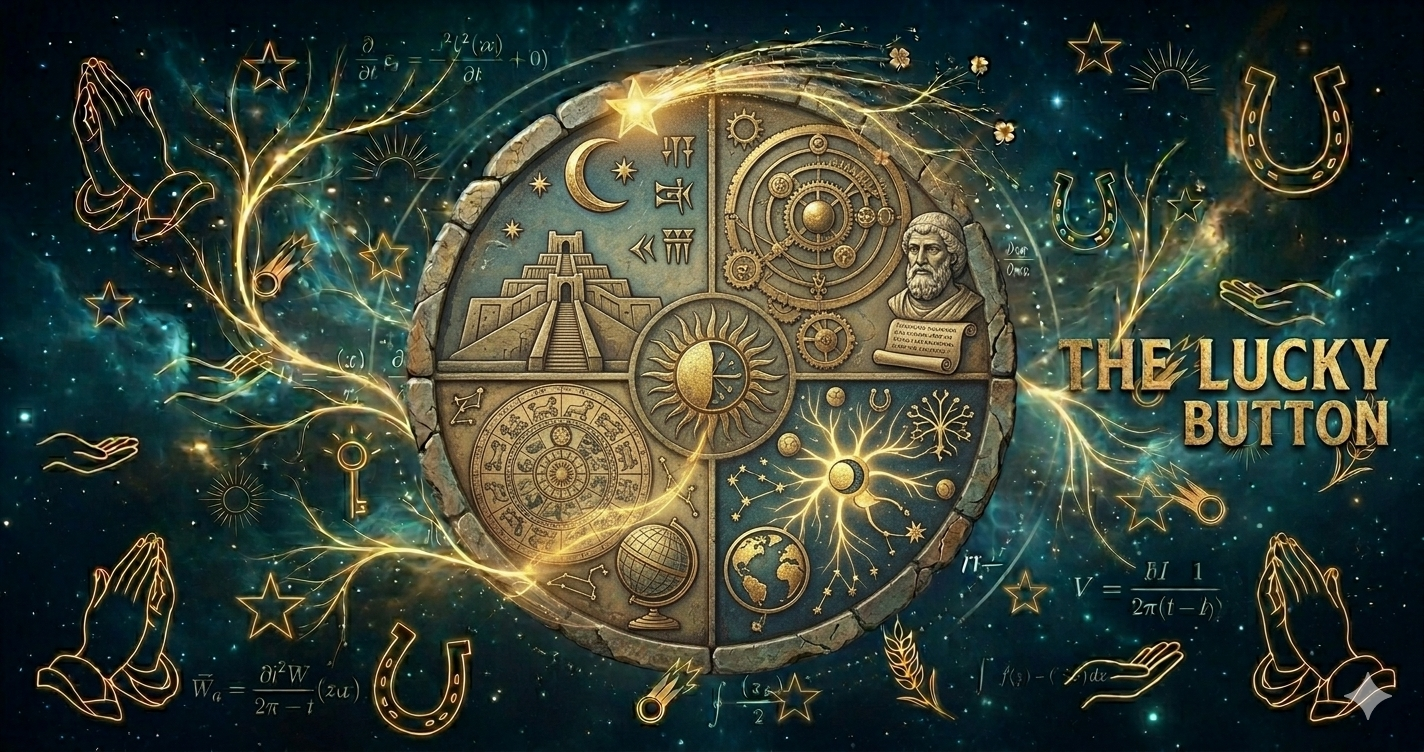
Lucky Button

Press For Instant Silliness!

The History of Astrology: Why People Still Believe in the Stars

By Lucky Button October 1, 2025


Walk into any bookstore and you’ll find dozens of astrology books. Open any social media app and you’ll see memes about Mercury retrograde and zodiac sign compatibility. Turn on the radio and someone will tell you what the stars have in store for your day.

Astrology is everywhere in modern culture, despite the fact that we’ve known for centuries that it has no scientific basis. This isn’t a story about gullible people believing silly things. This is a story about one of humanity’s oldest attempts to find meaning and guidance in an uncertain world.

Understanding why astrology has survived for over 4,000 years—and why it’s more popular than ever—tells us something important about human nature, our relationship with uncertainty, and our eternal search for purpose and direction.

The story of astrology is really the story of how humans have always tried to make sense of their lives and predict their futures, using whatever tools seemed most powerful at the time.

From Astronomy to Astrology: The Ancient Split

For most of human history, astronomy and astrology were the same thing. The people who studied the stars also believed the stars influenced human affairs. This wasn’t because ancient people were less intelligent than us—it was because they had different information about how the universe worked.

Why the Ancient Connection Made Sense

Observable Patterns: The sun clearly affected daily life (day/night, seasons), so why not other celestial bodies?

Navigation and Timing: Stars were essential for travel and agriculture, proving their practical importance

Rare Events: Eclipses and comets often coincided with major historical events by pure chance

Mathematical Precision: Ancient astronomers could predict eclipses and planetary movements with remarkable accuracy

Religious Integration: Most cultures saw gods and spiritual forces in natural phenomena

Limited Scientific Method: There was no way to test cause-and-effect relationships scientifically

For ancient civilizations, the sky was like a giant clock and calendar combined. It told them when to plant crops, when to expect floods, and when religious festivals should occur. Since the stars were clearly powerful enough to control these important aspects of life, it seemed logical that they might also influence personal matters like personality, relationships, and major life events.

The connection felt even stronger because ancient people lived much closer to natural rhythms than we do today. They went to bed when it got dark and woke up when it got light. They planned their entire year around seasonal changes. The stars weren’t just distant lights—they were an integral part of daily survival.

This practical relationship with astronomy made the jump to astrology feel natural and reasonable. If the stars could predict when winter was coming, why couldn’t they predict when love was coming?

Babylonian Stargazers: The First Astrologers

Around 2000 BCE, the Babylonians likely became the first people to develop something close to what we now call astrology. Renowned for their astronomical skills, they produced the earliest star charts, mapped the zodiac constellations, and even learned to forecast eclipses with remarkable precision.

Babylonian Astrological Innovations

The Zodiac Belt: Divided the sky into 12 sections based on prominent constellations

Planetary Movements: Tracked Mercury, Venus, Mars, Jupiter, and Saturn with mathematical precision

Omen Reading: Connected unusual celestial events with earthly happenings

Calendar Systems: Used astronomical observations to create accurate calendars

Royal Astrology: Advised kings and rulers on important political decisions

Medical Applications: Believed planetary positions affected health and disease

Their version of astrology, however, looked very different from today’s practices. It wasn’t concerned with personal traits or daily horoscopes but with large-scale events such as wars, famines, and the destiny of rulers and empires.

Serving more like political advisors, Babylonian astrologers used celestial patterns to guide kings in their decisions. Instead of predicting whether someone might enjoy a good day, they tried to determine whether the kingdom would prosper with abundant harvests or face hardship.

This “mundane astrology” fit the realities of the time, since a monarch’s choices could determine the survival of an entire population. Insights about when to launch a military campaign or embark on trade ventures carried enormous value if they came from the stars.

Many of the technical building blocks of modern astrology also trace back to Babylon. The 12-house system and the interpretation of planetary aspects were not just mystical inventions but genuine mathematical innovations that later generations built upon.

How the Greeks Gave Us Modern Astrology

The Greeks took Babylonian astronomical knowledge and transformed it into something much more personal and psychological. Around 300 BCE, they developed the idea that the positions of planets at the moment of someone’s birth could influence their personality and destiny.

Greek Astrological Developments

Personal Birth Charts: Individual horoscopes based on exact birth time and location

Psychological Focus: Personality traits and character analysis through planetary positions

Four Elements: Fire, earth, air, and water as fundamental personality categories

Planetary Rulership: Each planet “ruled” different aspects of human behavior

Aspects and Houses: Complex mathematical relationships between planetary positions

Predictive Techniques: Methods for forecasting future events and timing

This shift from political astrology to personal astrology was revolutionary. Instead of just advising kings, astrologers could now provide guidance to ordinary people about their relationships, careers, and personal growth.

The Greeks were the first to weave astrology together with philosophy and psychology, giving it a deeper intellectual foundation. Rather than treating it as mere fortune-telling, they regarded it as a tool for uncovering the hidden patterns and purposes of human life.

Astrologers such as Ptolemy produced detailed manuals that outlined the casting and interpretation of birth charts. With their mathematical precision and thorough explanations, these works became the definitive references in astrology for more than a thousand years.

Astrology was also tied to Greek medical theories, where each zodiac sign was thought to govern a specific part of the body. This belief shaped medical practice well into the Renaissance and left a lasting mark on European medicine.

The Zodiac System We Know Today

The 12 zodiac signs that everyone knows today—Aries, Taurus, Gemini, and so on—come from a combination of Babylonian astronomy and Greek interpretation. But the system has changed significantly over the past 2,000 years.

Zodiac Myths vs. Reality

MYTH: Zodiac signs are based on where the sun actually is among the stars

REALITY: Due to Earth’s wobble, the signs are now about one month off from the actual constellations

MYTH: There are exactly 12 zodiac constellations of equal size

REALITY: The real constellations vary widely in size, and astronomers recognize 13 zodiac constellations

MYTH: The zodiac has always been the same throughout history

REALITY: Different cultures have used different numbers of signs and different starting points

MYTH: Personality traits come from the stars in each constellation

REALITY: The personality descriptions were created by humans and assigned to the signs

The zodiac as we know it today is actually a mathematical convenience more than an astronomical reality. Ancient astronomers divided the sky into 12 equal sections of 30 degrees each, even though the actual constellations don’t fit neatly into these divisions.

Over the centuries, the Earth’s axis has slowly shifted in a process called precession. This means that when someone is “born under Virgo” today, the sun is actually in the constellation Leo. Most astrologers ignore this astronomical fact and continue using the ancient system.

The personality traits associated with each sign have also evolved over time. Modern descriptions of zodiac signs often reflect contemporary psychology and cultural values more than ancient beliefs about planetary influences.

For example, the idea that Scorpios are “mysterious and intense” or that Geminis are “communicative and versatile” comes from 20th-century astrologers who wanted to make astrology more psychologically sophisticated and personally relevant.

Why Astrology Survived the Scientific Revolution

You might expect that astrology would have disappeared once scientists like Copernicus, Galileo, and Newton explained how the solar system actually works. But astrology proved remarkably adaptable and survived by changing its claims and methods.

How Astrology Adapted to Science

Shifted Focus: From predicting specific events to describing personality types and general tendencies

Became More Vague: Horoscopes became less specific and more open to interpretation

Psychological Language: Adopted terms from psychology and therapy to sound more scientific

Embraced Subjectivity: Emphasized personal meaning and self-reflection over objective truth

Cultural Integration: Became part of entertainment and lifestyle rather than serious prediction

Modernized Delivery: Used new technologies like newspapers, radio, and eventually the internet

As science demonstrated that planetary positions don’t actually influence human behavior, astrology gradually moved away from making specific, testable predictions. Instead, it began focusing on psychological insights and personal reflection.

Modern astrology often positions itself as a tool for self-understanding rather than fortune-telling. Astrologers might say things like “Mars in your fifth house suggests you’re feeling more creative this month” instead of “You will meet a tall, dark stranger on Tuesday.”

This shift made astrology much harder to disprove because it became more about interpretation and feelings than about factual predictions. If an astrologer says “you’re going through a period of personal growth,” how would you prove that wrong?

Astrology also benefited from the rise of psychology in the 20th century. Concepts like personality types, unconscious motivations, and life stages gave astrology a new vocabulary that sounded scientific even when it wasn’t based on scientific research.

The Newspaper Horoscope Invention

The daily horoscope that millions of people read today is actually a very recent invention. It was created in 1930 by a British astrologer named R.H. Naylor for the London Sunday Express newspaper.

How Daily Horoscopes Changed Everything

Mass Market Appeal: Made astrology accessible to everyone, not just wealthy clients

Simplified Astrology: Reduced complex birth charts to simple sun sign predictions

Daily Habit: Created a routine that kept people engaged with astrology regularly

Entertainment Format: Presented astrology as fun diversion rather than serious guidance

Commercial Success: Proved that astrology content could sell newspapers and magazines

Cultural Penetration: Introduced astrological concepts to people who might never have encountered them otherwise

Before newspaper horoscopes, astrology required expensive personal consultations with trained astrologers who would create detailed birth charts. The average person couldn’t afford this service and wouldn’t have known how to find a qualified astrologer.

Naylor’s innovation was to create general predictions based only on someone’s sun sign—the zodiac sign determined by their birth month. This was astrologically much simpler but made astrology available to everyone who could read a newspaper.

The format was immediately popular and spread to newspapers around the world. By the 1960s, almost every major newspaper carried daily horoscopes, and the feature had become a standard part of popular culture.

Daily horoscopes also changed what people expected from astrology. Instead of seeking major life guidance or cosmic understanding, people began using astrology for casual entertainment and minor daily decisions.

This shift from serious astrology to entertainment astrology helped the practice survive in a scientific age by lowering the stakes and reducing the pressure for accuracy.

Psychology Behind Believing in Astrology

Modern psychology has identified several reasons why astrology feels believable and helpful to many people, even when it’s not actually accurate. These psychological factors explain astrology’s enduring appeal better than any claims about planetary influences.

Why Astrology Feels True

Need for Control: Believing in astrology can provide a sense of predictability in an uncertain world

Confirmation Bias: People remember hits and forget misses when evaluating astrological accuracy

Self-Fulfilling Prophecy: Believing a prediction can actually make it more likely to come true

Social Connection: Astrology provides a shared language for discussing personality and relationships

Meaning-Making: Helps people find patterns and significance in random events

Identity Formation: Zodiac signs offer ready-made personality frameworks for self-understanding

One of the strongest psychological appeals of astrology is that it offers explanations for things that are otherwise difficult to understand. Why did that relationship fail? Why do you feel anxious lately? Why does your coworker act that way? Astrology provides simple answers to complex questions.

Astrology is also appealing because it’s generally optimistic and focuses on personal growth. Most horoscopes emphasize positive possibilities and frame challenges as opportunities for development. This positive outlook can genuinely improve people’s mood and confidence.

The language of astrology also gives people vocabulary for discussing personality traits and interpersonal dynamics. Saying “I’m such a Virgo” or “that’s so typical Scorpio behavior” provides a socially acceptable way to talk about psychological patterns without getting too personal or clinical.

Research shows that people who believe in astrology often score higher on measures of stress and anxiety. This suggests that astrology might serve as a coping mechanism for people who are struggling with uncertainty or feeling overwhelmed by life’s complexity.

The Barnum Effect: Why Horoscopes Feel Accurate

Psychologists have identified a specific cognitive bias that explains why horoscopes and astrological readings feel so accurate to so many people. It’s called the Barnum Effect, named after circus owner P.T. Barnum, who was famous for having “something for everyone.”

How the Barnum Effect Works

Vague Statements: Horoscopes use general descriptions that could apply to almost anyone

Positive Bias: Most statements are flattering or at least neutral, making people want to believe them

Multiple Interpretations: Ambiguous language allows readers to find personal meaning in generic text

Confirmation Seeking: People actively look for ways that the description fits their experience

Selective Memory: Readers remember the parts that seemed accurate and forget the misses

Personal Validation: Being “understood” by a horoscope feels good, even when it’s not actually personal

Classic Barnum Effect statements include things like “You have a great deal of unused capacity which you have not turned to your advantage” or “At times you are extroverted, affable, and sociable, while at other times you are introverted, wary, and reserved.”

These statements feel personally meaningful because they describe universal human experiences. Almost everyone has unused potential, and almost everyone acts differently in different social situations. But when you read these descriptions in your personal horoscope, they feel like insights into your unique personality.

Psychologists have tested the Barnum Effect by giving people identical personality descriptions while telling them the descriptions were personalized. Most people rate these generic descriptions as highly accurate and personally relevant.

The Barnum Effect is so powerful that it works even when people are told about the bias beforehand. Knowing that horoscopes are designed to feel universal doesn’t completely eliminate their psychological appeal.

This research doesn’t mean that people who believe in astrology are stupid or gullible. It means that human psychology is wired in ways that make certain types of beliefs feel compelling, regardless of their factual accuracy.

Modern Astrology and Social Media

Social media has given astrology a massive boost in popularity, especially among younger generations. Instagram, TikTok, and Twitter have created new ways for people to engage with astrological content that are more interactive and personalized than traditional horoscopes.

Astrology in the Digital Age

Meme Culture: Zodiac sign memes make astrology entertaining and shareable

Micro-Content: Short, digestible astrological insights perfect for social media consumption

Visual Appeal: Beautiful star charts, constellation graphics, and aesthetic astrology content

Community Building: Online groups where people with the same signs can connect and share experiences

Instant Access: Apps that provide personalized readings and daily predictions

Influencer Astrologers: Popular social media personalities who teach and promote astrological concepts

Modern social media astrology tends to be more casual and less serious than traditional astrology. People share memes about Mercury retrograde affecting their WiFi, or joke about their zodiac sign explaining their coffee preferences.

This lighter approach has made astrology more accessible to people who might have dismissed it as too mystical or serious in the past. When astrology is presented as fun content rather than profound wisdom, the barriers to engagement are much lower.

Social media has also allowed for more diverse voices in astrology. Traditional astrology was dominated by white, male authorities, but social platforms have elevated astrologers from many different backgrounds who bring new perspectives to ancient practices.

The visual nature of platforms like Instagram has also changed how astrology is presented. Modern astrological content often emphasizes beautiful imagery, stylish graphics, and aesthetic appeal as much as informational content.

However, social media astrology also tends to be less accurate and more simplified than traditional astrological practice. The pressure to create viral content can lead to oversimplified or sensationalized astrological claims.

What Science Actually Says About Astrology

Scientists have conducted numerous studies to test whether astrology actually works, and the results are consistently clear: there is no scientific evidence that planetary positions influence human personality or predict future events.

Scientific Tests of Astrology

Twin Studies: Twins born minutes apart should have nearly identical personalities according to astrology, but they don’t

Astrologer Challenges: Professional astrologers perform no better than chance when asked to match personality descriptions to birth charts

Large Population Studies: No correlation between birth dates and personality traits, career choices, or life outcomes

Prediction Testing: Astrological predictions are consistently no more accurate than random guessing

Gravitational Analysis: The gravitational influence of planets on humans is far weaker than everyday objects like furniture

Precession Problem: Astrology ignores the fact that Earth’s position relative to the stars has shifted significantly since ancient times

One of the most comprehensive tests was conducted by physicist Shawn Carlson in the 1980s. He worked with astrologers to design a fair test where professional astrologers would try to match personality descriptions to birth charts. The astrologers were confident they would succeed, but their results were no better than random chance.

Another famous study tested the idea that people born under certain signs share personality traits. Researchers analyzed the birth dates and personality test scores of thousands of people and found no significant correlations between zodiac signs and psychological characteristics.

From a physics perspective, the gravitational influence of planets on a newborn baby is extraordinarily weak—much weaker than the gravitational influence of the doctor delivering the baby or the furniture in the hospital room.

The scientific consensus is clear: astrology is not an effective way to understand personality or predict future events. However, this doesn’t necessarily mean that astrology has no value at all.

Some researchers have found that people who use astrology for self-reflection and personal insight can benefit from the process, even if the astrological content itself isn’t accurate. The act of thinking deeply about your personality, relationships, and goals can be valuable regardless of whether the framework you use is scientifically valid.

Why People Still Believe Despite the Evidence

Even when people learn that astrology has no scientific basis, many continue to find it meaningful and helpful. This isn’t necessarily a failure of education or critical thinking—it often reflects different goals and values that go beyond scientific accuracy.

Non-Scientific Reasons People Value Astrology

Comfort and Reassurance: Provides emotional support during difficult times

Social Connection: Creates bonds with friends and communities who share the interest

Self-Reflection Tool: Encourages thinking about personality, goals, and relationships

Cultural Identity: Connects people to historical traditions and alternative worldviews

Entertainment Value: Offers fun, low-stakes way to explore ideas about personality and fate

Sense of Wonder: Maintains connection to mystery and magic in an increasingly scientific world

Many people who believe in astrology are fully aware that it’s not scientifically proven. They choose to engage with it anyway because it serves psychological and social functions that science doesn’t necessarily provide.

For some, astrology is a form of spiritual practice that helps them feel connected to something larger than themselves. For others, it’s simply a fun way to think about personality and relationships without taking it too seriously.

Research shows that belief in astrology often increases during times of stress, uncertainty, or major life transitions. When people feel overwhelmed by circumstances beyond their control, astrology can provide a sense of meaning and direction.

Astrology also thrives in cultures that value individual expression and personal growth. The focus on understanding your “true self” and fulfilling your potential resonates with modern self-help and wellness movements.

Importantly, many people use astrology as a starting point for deeper conversations about psychology and philosophy, rather than as a definitive guide to truth. The question “What’s your sign?” can lead to discussions about personality, values, and life experiences that might not happen otherwise.

Astrology as Modern Psychology Tool

Some therapists and counselors have found ways to use astrological concepts as therapeutic tools, without necessarily believing in the literal truth of astrological claims. This approach treats astrology as a kind of psychological metaphor or framework for self-exploration.

Therapeutic Uses of Astrological Concepts

Personality Exploration: Using zodiac traits as starting points for discussing behavioral patterns

Relationship Dynamics: Exploring compatibility and conflict through astrological frameworks

Life Transitions: Using planetary cycles as metaphors for personal growth phases

Self-Acceptance: Helping people understand their traits as part of their “cosmic design”

Goal Setting: Using astrological timing concepts to plan personal development

Creative Expression: Incorporating mythological and symbolic elements into therapy

This approach, sometimes called “archetypal astrology” or “psychological astrology,” focuses on the symbolic and metaphorical value of astrological concepts rather than their literal accuracy.

For example, a therapist might help a client explore their tendency toward perfectionism by discussing “Virgo energy” and the mythological themes associated with that sign. The goal isn’t to prove that Virgo influences behavior, but to use familiar astrological language to make psychological concepts more accessible and engaging.

Some people find this approach more comfortable than traditional therapy because it feels less clinical and more personally meaningful. Discussing your “Saturn return” might feel more approachable than discussing “quarter-life crisis anxiety.”

However, mental health professionals who use astrological concepts typically emphasize that these are tools for reflection and conversation, not diagnostic or predictive methods. The therapeutic value comes from the self-reflection process, not from the astrological content itself.

This therapeutic approach also acknowledges that human psychology includes a need for meaning, narrative, and connection to something beyond immediate material concerns. Astrology can fulfill these needs even when it doesn’t provide factual information.

“Astrology is not about the stars and planets. It’s about time, and our perception of time. It’s about how we organize our inner and outer experiences.”

— Richard Tarnas, Professor of Philosophy and Psychology

The Future of Astrology in a Scientific World

Rather than disappearing in our increasingly scientific age, astrology seems to be adapting and thriving. Its future probably lies not in competing with science for factual accuracy, but in serving psychological and cultural needs that science doesn’t address.

Modern astrology is becoming more sophisticated in acknowledging its limitations while maintaining its appeal. Many contemporary astrologers describe their practice as “symbolic language” or “psychological tool” rather than making specific claims about planetary influences.

This evolution allows astrology to coexist with scientific thinking without direct conflict. People can appreciate astronomy for understanding the physical universe while using astrological concepts for personal reflection and meaning-making.

The rise of personalized technology may also give astrology new forms. Apps that combine astrological frameworks with psychological research, or AI systems that use zodiac concepts to generate personalized content, could create hybrid approaches that serve both entertainment and self-reflection functions.

However, astrology will likely continue to face challenges from critical thinking education and scientific literacy. As more people understand concepts like the Barnum Effect and confirmation bias, they may become less susceptible to astrological claims.

The key to astrology’s continued relevance may be its ability to evolve from making factual claims to providing psychological and cultural value. Like mythology, literature, or art, astrology might find its place as a meaningful human creation rather than a description of objective reality.

Understanding the Appeal Without the Belief

You don’t have to believe in astrology to understand why it’s meaningful to so many people. The human needs that astrology addresses—for meaning, community, self-understanding, and hope—are universal and legitimate.

Understanding astrology’s history and psychology can help us appreciate both its cultural significance and its limitations. It’s a fascinating example of how humans create systems of meaning and how those systems evolve over time.

For those who enjoy astrology, understanding its psychological basis can enhance the experience without necessarily diminishing it. Knowing that horoscopes work through the Barnum Effect doesn’t make them less entertaining or thought-provoking.

For those who are skeptical of astrology, understanding its appeal can foster empathy for people who find it meaningful. The desire for guidance and self-understanding is universal, even if people pursue it through different methods.

The story of astrology is ultimately a story about human nature—our curiosity about the universe, our need for meaning and connection, and our remarkable ability to create and adapt belief systems that serve our psychological and social needs.

Whether you read your horoscope every day or dismiss astrology entirely, understanding its 4,000-year journey from Babylonian astronomy to Instagram memes reveals something important about what it means to be human in an uncertain world.

Ready to explore how you make decisions when facing uncertainty? Try our Lucky Button and notice whether you approach unknown outcomes with optimism, anxiety, or curiosity. Understanding your own relationship with uncertainty can help you navigate everything from daily choices to major life decisions, whether you consult the stars or rely on other sources of guidance.

Tags:

Astrology
Horoscopes
Ancient History
Psychology
Zodiac Signs
Babylonian Astronomy
Greek Philosophy
Barnum Effect
Social Media
Scientific Method
Beliefs
Cultural History

Experience The Lucky Button

Curious about how you approach uncertainty and the unknown? Try our Lucky Button and pay attention to your decision-making process. Do you seek guidance from external sources, trust your intuition, or rely on logic? Understanding your approach to uncertainty can help you make better decisions regardless of whether you consult horoscopes, scientific research, or your own inner wisdom.


Lucky Button - Daily dose of positivity connecting ancient wisdom with modern psychology

Explore Your Cosmic Curiosity

Tell Us: What does luck mean to you?

Drop a comment below or hit the Lucky Button and start your journey today.