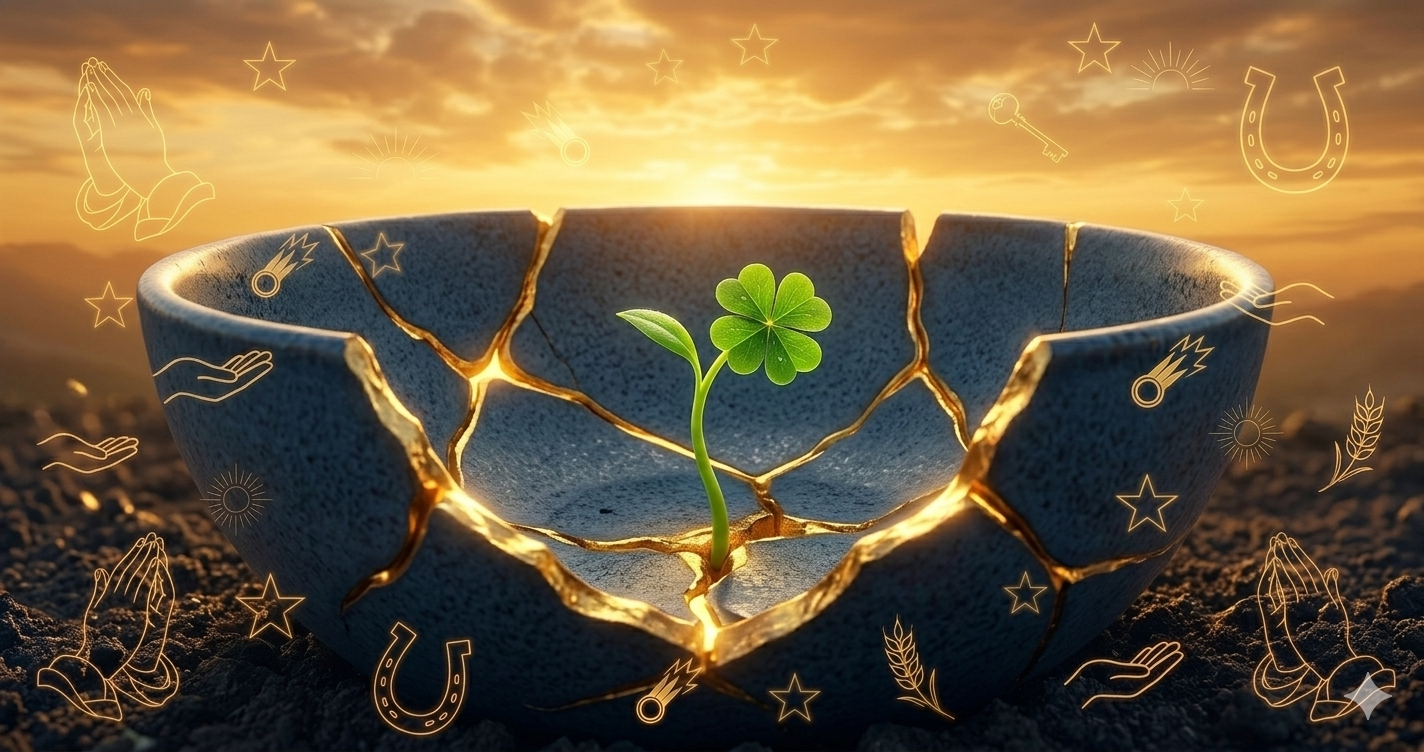
When Bad Luck Becomes the Best Thing That Ever Happened
In 1997, a single mother living on government assistance in Edinburgh sat in a cafe and wrote stories about a boy wizard. She had recently survived a difficult divorce, struggled with depression, and described herself as "the biggest failure I knew." Her name was J.K. Rowling, and the manuscript she was working on had already been rejected by twelve publishers.
Stories like Rowling's are so common among successful people that researchers have given the phenomenon a name: post-traumatic growth. It turns out that adversity, setbacks, and even genuine trauma can become powerful catalysts for personal development — not despite the pain they cause, but in many ways because of it.
This is not a motivational cliche or an invitation to minimize suffering. The science of resilience reveals specific psychological mechanisms that allow some people to transform misfortune into advantage, and these mechanisms can be deliberately cultivated.
Post-Traumatic Growth: The Science of Transformation Through Adversity
In the mid-1990s, psychologists Richard Tedeschi and Lawrence Calhoun at the University of North Carolina at Charlotte coined the term "post-traumatic growth" (PTG) to describe the phenomenon of positive psychological change following highly challenging life circumstances.
Their research, published in the Journal of Traumatic Stress, identified five domains in which people commonly experience growth after adversity:
1. Greater appreciation of life. After surviving hardship, many people report a deeper appreciation for everyday experiences they previously took for granted.
2. New possibilities. Adversity often forces people onto paths they would never have chosen, opening doors they did not know existed. Career changes, new relationships, and creative pursuits frequently emerge from periods of difficulty.
3. Improved relationships. Shared struggle deepens bonds. People who have experienced adversity often report stronger, more authentic relationships built on vulnerability and mutual support.
4. Greater personal strength. The discovery that you can survive something terrible creates a reservoir of confidence. As Tedeschi writes, people often describe this as "I am more vulnerable than I thought, but much stronger than I ever imagined."
5. Spiritual or existential development. Adversity frequently prompts deeper engagement with questions of meaning, purpose, and values. This does not necessarily mean religious conversion — it refers to a broader deepening of philosophical reflection.
Importantly, PTG does not require the absence of distress. Growth and suffering coexist. People can experience profound grief and meaningful growth simultaneously. The research suggests that it is the struggle with adversity, not the adversity itself, that produces growth.
Famous Transformations: From Misfortune to Meaning
The pattern of transforming bad luck into opportunity appears across virtually every field of human achievement:
Steve Jobs was famously fired from Apple, the company he co-founded, in 1985. He later said that being fired was the best thing that could have happened to him. During his time away from Apple, he founded NeXT (whose technology became the foundation of modern macOS), acquired Pixar (which became the most successful animation studio in history), and developed the perspective that made his return to Apple so transformative.
Oprah Winfrey grew up in extreme poverty in rural Mississippi, experienced abuse, and became a teenage mother whose son died in infancy. She has spoken extensively about how these experiences gave her the empathy, drive, and authenticity that became the foundation of her career as one of the most influential media figures in history.
Frida Kahlo survived a devastating bus accident at age 18 that left her with lifelong chronic pain. During her long recovery, confined to bed in a body cast, she began painting — using a specially designed easel that allowed her to work while lying down. Her art, deeply informed by her suffering, became some of the most important and beloved work of the 20th century.
These are not stories of people who succeeded despite adversity. They are stories of people whose adversity provided raw material that, processed through resilience, became the foundation of extraordinary achievement.
Cognitive Reappraisal: The Core Skill of Resilience
At the heart of resilience is a cognitive skill called reappraisal — the ability to reinterpret the meaning of an event without denying its reality. This is not the same as "looking on the bright side" or minimizing pain. It is a sophisticated mental operation that changes the emotional impact of an event by changing how you understand it.
Neuroscience research by Kevin Ochsner and James Gross at Columbia and Stanford universities has shown that cognitive reappraisal activates prefrontal cortex regions involved in executive function and emotion regulation, while simultaneously reducing activation in the amygdala (the brain's threat detection center). In other words, reappraisal literally changes the brain's response to negative events.
Effective reappraisal strategies include:
Temporal distancing: Asking "How will I feel about this in five years?" instantly reduces the emotional intensity of current setbacks.
Benefit finding: Deliberately searching for any positive consequences or lessons in a negative event. Research shows this is one of the strongest predictors of long-term adjustment after adversity.
Perspective taking: Considering how someone you admire would view and respond to the situation. This activates problem-solving circuits rather than rumination loops.
Narrative reconstruction: Rewriting the story of the event with yourself as a protagonist overcoming a challenge rather than a victim of circumstances. Research by James Pennebaker at the University of Texas has shown that narrative writing about difficult events produces measurable improvements in physical and mental health.
Kintsugi: The Art of Golden Repair
The Japanese art of kintsugi offers a beautiful metaphor for resilience. When a ceramic bowl or vase breaks, a kintsugi artist repairs it using lacquer mixed with powdered gold. The result is a piece that is more beautiful than the original — its history of breakage is not hidden but highlighted, transformed into a feature rather than a flaw.
The philosophy behind kintsugi is called "wabi-sabi," which embraces imperfection, impermanence, and incompleteness as sources of beauty. Applied to human resilience, kintsugi suggests that our breaks and repairs are not weaknesses to be concealed but sources of strength and character to be honored.
This is not merely poetic. Research on "scar tissue" in organizations, relationships, and individuals consistently shows that systems that have been stressed and repaired are often stronger than those that have never been tested. Nassim Nicholas Taleb calls this property "antifragility."
Building Antifragility: Beyond Mere Resilience
In his book Antifragile (2012), Taleb distinguishes between three categories: the fragile (things that break under stress), the resilient (things that withstand stress), and the antifragile (things that actually get stronger from stress). A wine glass is fragile. A rock is resilient. A muscle is antifragile — it grows stronger from the very force that could damage it.
Taleb argues that many of the most important systems — biological, economic, psychological — are designed to be antifragile. The immune system needs exposure to pathogens to develop. Bones need stress to maintain density. And human psychological growth often requires adversity to develop depth, wisdom, and strength.
The practical implication is profound: rather than merely trying to avoid bad luck, we can develop systems and habits that allow us to benefit from it. This requires:
Exposure to manageable challenges. Deliberately seeking out difficulties that stretch your capabilities without overwhelming them. This is the principle behind progressive training in athletics, and it applies equally to psychological resilience.
Redundancy and optionality. Maintaining multiple projects, skills, and relationships so that a setback in one area does not cascade into total failure. Antifragile systems have backup options.
Fast feedback and adaptation. Learning quickly from failures rather than repeating the same approaches. This requires both honest self-assessment and the willingness to change course.
Practical Resilience Exercises
The "worst case" inventory: Write down the worst thing that has happened to you in the past five years. Then list every positive outcome, lesson, relationship, or strength that emerged from it — however indirectly. Most people are surprised by how long the second list becomes.
Daily micro-reappraisals: At the end of each day, identify one negative event and practice reappraising it. Ask: "What did I learn? What new possibility does this create? How am I stronger for having experienced this?"
Expressive writing: Spend 20 minutes writing about a difficult experience, focusing on your deepest thoughts and feelings about it. Research by Pennebaker shows that four sessions of this exercise produce lasting improvements in mood, health, and cognitive processing.
The kintsugi reflection: Identify a "broken" area of your life — a failure, loss, or disappointment. Instead of trying to hide or forget it, consider how it has shaped you. What gold has formed in the cracks? How has the repair made you more interesting, more compassionate, or more capable?
Stress inoculation: Deliberately take on small, manageable challenges outside your comfort zone. Cold showers, difficult conversations, public speaking, physical challenges — each one builds the neural circuitry of resilience that will serve you when larger challenges arrive uninvited.
The deepest truth about luck and resilience is this: you cannot control what happens to you, but you can develop the capacity to transform whatever happens into material for growth. The luckiest people are not those who avoid misfortune — they are those who have learned to turn misfortune into fuel.
📚 References & Further Reading
- Posttraumatic Growth: Conceptual Foundations and Empirical Evidence — Tedeschi, R. G., & Calhoun, L. G. (2004)
- Antifragile: Things That Gain from Disorder — Taleb, N. N. (2012)
- The Cognitive Control of Emotion — Ochsner, K. N., & Gross, J. J. (2005)
- Writing About Emotional Experiences as a Therapeutic Process — Pennebaker, J. W. (1997)
Lucky Button Team
Educators & Probability Researchers
A multidisciplinary team of psychology graduates, data scientists, and educators dedicated to making the science of luck accessible and fun.
Learn more about our team →Join the Conversation
Tell Us: What does luck mean to you?
Loading comments...