Lucky Button

Press For Instant Silliness!

📊 Probability & Statistics: The Math Behind Luck

By Lucky Button July 8, 2025


Unlock the mathematical secrets behind luck, chance, and random events. Explore how probability theory and statistical analysis reveal the hidden patterns in seemingly random occurrences, from lottery odds to everyday coincidences, and learn how understanding these concepts can dramatically improve your decision-making in all areas of life.


The answer lies in mathematics—specifically, in the fascinating realms of probability and statistics. What we perceive as luck, fortune, or cosmic favoritism often follows predictable mathematical patterns that can be measured, analyzed, and understood.

This isn’t about removing the magic from life’s surprises. Instead, understanding the mathematics behind chance events can help you make better decisions, set realistic expectations, and even position yourself to benefit from favorable odds when they arise.

Welcome to the mathematical world of luck, where numbers reveal the hidden logic behind chaos and probability becomes your most powerful decision-making tool.

The Foundation: Understanding Probability

Probability is the mathematical language we use to describe uncertainty and chance. At its core, probability quantifies how likely an event is to occur, expressed as a number between 0 (impossible) and 1 (certain), or as a percentage between 0% and 100%.

Basic Probability Concepts

Fundamental probability theory operates on several key principles that govern how we calculate and interpret chances:

🎲 Simple Probability Examples

Fair Coin Flip (Heads):

50% (1/2)

Rolling a 6 on Die:

16.67% (1/6)

Drawing Ace from Deck:

7.69% (4/52)

These simple examples demonstrate the basic formula for probability:

Probability = (Number of Favorable Outcomes) / (Total Number of Possible Outcomes)

However, real-world probability quickly becomes more complex. Most events we encounter aren’t simple coin flips—they involve multiple variables, dependencies, and complications that require sophisticated mathematical analysis.

Independent vs. Dependent Events

Understanding the distinction between independent and dependent events is crucial for accurate probability calculation and avoiding common misconceptions about luck.

Independent Events: The outcome of one event doesn’t affect the probability of another. Each coin flip, dice roll, or lottery drawing is independent of previous results. This is where many people fall into the gambler’s fallacy trap—believing that past results influence future probabilities in independent events.

Dependent Events: The outcome of one event affects the probability of subsequent events. Drawing cards from a deck without replacement is a classic example—each card drawn changes the composition of the remaining deck and affects future probabilities.

📈 Real-World Application: Stock Market

Stock price movements demonstrate complex probability in action. While short-term price changes may seem random, they’re influenced by countless dependent variables: company performance, market sentiment, economic indicators, and global events. Understanding this helps explain why “lucky” investors often combine skill, timing, and favorable probability rather than pure chance.

Probability Distributions: The Architecture of Randomness

While individual random events may be unpredictable, collections of random events often follow predictable patterns called probability distributions. These distributions reveal the hidden structure within apparent randomness.

The Normal Distribution: Nature’s Favorite Pattern

The normal distribution, also known as the Gaussian distribution or bell curve, is perhaps the most important concept in statistics. This distribution appears everywhere in nature and human behavior, explaining why many phenomena cluster around average values with fewer extreme outcomes.

🔔 Bell Curve Examples in Daily Life

Human Characteristics

Heights: Most people cluster around average height (5’4″ – 5’10”), with very few extremely tall or short individuals.

IQ Scores: Designed to follow a normal distribution with mean 100 and standard deviation 15.

Test Scores: In large populations, test scores typically form a bell curve around the average.

Natural Phenomena

Measurement Errors: Random errors in scientific measurements follow normal distributions.

Blood Pressure: Population blood pressure readings cluster around healthy norms.

Birth Weights: Newborn weights follow a normal distribution with most babies near average weight.

Understanding normal distributions helps explain why extreme events (both positive and negative) are genuinely rare. When someone experiences an extremely lucky or unlucky event, they’re often encountering the natural extremes of a distribution—statistically expected but personally surprising.

Other Important Distributions

Different types of events follow different distribution patterns, each with unique characteristics and applications:

Distribution Type Characteristics Real-World Examples
Binomial Distribution Fixed number of trials, success/failure outcomes Free throw shooting, quality control testing
Poisson Distribution Rate of rare events over time Website visitors per hour, accident rates
Exponential Distribution Time between events Equipment failure rates, customer service wait times
Power Law Distribution Few extreme values, many small values Income distribution, city populations, viral content

Recognizing which distribution applies to a situation helps predict likely outcomes and identify genuinely unusual events. This knowledge connects to research on why some people feel luckier than others—those who understand probabilistic thinking may better calibrate their expectations and recognize true opportunities.

Statistical Significance: Separating Signal from Noise

One of statistics’ most powerful contributions is helping us distinguish meaningful patterns from random fluctuations. This concept, known as statistical significance, prevents us from drawing incorrect conclusions from limited data or chance occurrences.

Understanding P-Values and Statistical Testing

The p-value is a fundamental concept in statistical hypothesis testing. Despite widespread use in scientific research, p-values are often misunderstood, leading to incorrect conclusions about causation and significance.

📊 P-Value Interpretation Guide

What a p-value actually means: If there were no real effect, what’s the probability of observing results this extreme or more extreme?

  • p < 0.05: Less than 5% chance of observing this result if no real effect exists (traditionally considered “significant”)
  • p < 0.01: Less than 1% chance—stronger evidence of a real effect
  • p < 0.001: Less than 0.1% chance—very strong evidence

What p-values DON’T tell us:

  • The probability that the hypothesis is true
  • The practical importance of the effect
  • Whether the result is due to chance alone

The Replication Crisis and Statistical Misunderstanding

The scientific community has grappled with a “replication crisis” where many published findings cannot be reproduced. Much of this stems from statistical misunderstanding, particularly:

  • P-hacking: Manipulating analysis methods until achieving desired p-values
  • Multiple Testing: Running many statistical tests and reporting only significant results
  • Publication Bias: Journals preferentially publishing positive results
  • Confusion of Statistical and Practical Significance: Small effects becoming “significant” with large sample sizes

Understanding these issues helps evaluate claims about luck, effectiveness of treatments, or success of strategies. Just because something appears statistically significant doesn’t mean it’s practically important or genuinely causal.

The Mathematics of Everyday “Luck”

Many experiences we attribute to luck follow predictable mathematical patterns. Understanding these patterns helps calibrate expectations and make better decisions.

Lottery Mathematics: Why Hope Costs So Much

Lotteries provide perfect examples of probability mathematics in action. The astronomical odds of winning major jackpots aren’t accidental—they’re carefully calculated to ensure the house advantage while maintaining enough hope to drive participation.

🎰 Powerball Probability Breakdown

Winning the Jackpot: 1 in 292,201,338

Calculation: C(69,5) × C(26,1) = 11,238,513 × 26 = 292,201,338

What this means in practice:

  • You’re 25 times more likely to be struck by lightning
  • 300 times more likely to be attacked by a shark
  • More likely to become President of the United States
  • If you bought one ticket per week, you’d expect to win once every 5.6 million years

Expected Value Analysis: Even with a $100 million jackpot, the expected value of a $2 ticket is typically negative, around $0.50-$0.70.

However, lottery mathematics becomes more interesting when considering the psychology of hope and entertainment value. People don’t buy lottery tickets purely for expected monetary return—they purchase dreams, excitement, and temporary escape from financial constraints.

Casino Mathematics: The House Edge Explained

Casinos operate on mathematical principles designed to ensure long-term profitability while providing enough short-term variation to maintain player interest. Understanding these principles reveals why “lucky streaks” at casinos are temporary fluctuations within predictable long-term patterns.

Game House Edge Player Return Mathematical Basis
European Roulette 2.7% 97.3% 37 numbers, 35:1 payout
Blackjack (Basic Strategy) 0.5% 99.5% Optimal mathematical play
Slot Machines 2-10% 90-98% Programmed RNG algorithms
Lottery 50% 50% Half of revenue returned as prizes

The house edge represents the casino’s long-term advantage, but short-term results can vary dramatically. This variation creates the illusion of luck while masking the underlying mathematical certainty.

Investment “Luck” and Market Mathematics

Financial markets provide fascinating examples of probability and statistics in action. Many investment outcomes attributed to skill or luck can be explained through mathematical analysis of risk, return distributions, and random walk theory.

Random walk theory suggests that stock price movements are largely unpredictable and follow a random pattern. This theory explains why:

  • Most active fund managers fail to beat market indexes consistently
  • Past performance doesn’t predict future returns
  • Market timing strategies rarely work long-term
  • Diversification mathematically reduces risk without sacrificing expected return

However, some investors do consistently outperform markets. The mathematical question becomes: are these results due to skill, luck, or a combination of both? Statistical analysis can help separate genuine skill from fortunate randomness, though the distinction isn’t always clear-cut.

🎯 Test Your Probability Knowledge!

Think you understand the mathematics behind luck and chance? Test your knowledge of probability theory, statistical concepts, and the mathematical principles discussed in this article!

Common Probability Fallacies and Misconceptions

Understanding probability mathematics helps identify and avoid common thinking errors that lead to poor decision-making and misinterpretation of random events.

The Gambler’s Fallacy: When Independence Confuses Intuition

The gambler’s fallacy represents one of the most pervasive and costly misconceptions about probability. This fallacy occurs when people believe that past results in independent events affect future probabilities.

⚠️ Gambler’s Fallacy Examples

Coin Flips: After five heads in a row, believing tails is “due” or more likely on the next flip.

Reality: Each flip remains 50/50 regardless of previous results.

Roulette: Thinking that red is more likely after a streak of black numbers.

Reality: Each spin is independent; the wheel has no memory.

Lottery Numbers: Avoiding numbers that won recently because they’re “unlikely” to repeat.

Reality: Each drawing is independent; all combinations are equally likely.

Research on the gambler’s fallacy shows it affects decision-making across many domains, from gambling to financial investments to sports predictions. Understanding this fallacy helps maintain accurate probability assessments in uncertain situations.

The Hot Hand Fallacy: When Streaks Feel Meaningful

Conversely, the hot hand fallacy involves believing that success streaks in random events will continue. Originally identified in basketball shooting, this concept applies broadly to situations where people perceive momentum in fundamentally random processes.

Interestingly, recent research has complicated the traditional view of the hot hand fallacy. While pure random processes show no streak effects, some activities involving skill may show genuine hot hand effects. The challenge lies in distinguishing skill-based momentum from random variation, which relates to our discussion of serendipity versus genuine pattern recognition.

The Availability Heuristic and Probability Estimation

People often estimate probabilities based on how easily they can remember examples of events. This availability heuristic leads to systematic probability estimation errors:

  • Overestimating rare but memorable events: Plane crashes, shark attacks, lottery wins
  • Underestimating common but unmemorable events: Heart disease, car accidents, gradual wealth building
  • Recent bias: Giving too much weight to recently observed events
  • Media influence: News coverage frequency doesn’t match actual probability

This heuristic explains why people often have poor intuitions about actual risks and opportunities, leading to suboptimal decision-making in health, finance, and life planning.

Advanced Probability Concepts: Beyond Basic Calculations

While basic probability provides a foundation for understanding chance, several advanced concepts reveal deeper insights into the mathematics of uncertainty and decision-making.

Bayes’ Theorem: Updating Beliefs with Evidence

Bayes’ theorem provides a mathematical framework for updating probability estimates when new information becomes available. This theorem underlies much of modern statistical inference and machine learning.

P(A|B) = [P(B|A) × P(A)] / P(B)
Probability of A given B = (Probability of B given A × Prior probability of A) / Probability of B

Bayesian thinking helps explain why initial impressions matter so much and why changing minds requires compelling evidence. It also reveals why rare events with high false positive rates (like certain medical tests) can be misleading.

🏥 Medical Testing Example

Scenario: A disease affects 1% of the population. A test is 99% accurate for both positive and negative results.

Question: If you test positive, what’s the probability you have the disease?

Intuitive Answer: 99% (matching test accuracy)

Bayesian Answer: About 50%

Explanation: The low base rate (1% prevalence) means most positive tests are false positives, despite the test’s high accuracy.

The Central Limit Theorem: Why Averages Behave Predictably

The Central Limit Theorem is one of the most important results in statistics. It states that averages of large samples from any distribution will approximate a normal distribution, regardless of the original distribution’s shape.

This theorem explains:

  • Why polling and surveys can be accurate with relatively small samples
  • How quality control works in manufacturing
  • Why casino profits are predictable despite individual game randomness
  • How insurance companies can operate profitably despite uncertain individual claims

Understanding the Central Limit Theorem helps explain why large-scale systems often behave predictably even when individual components are highly variable or random.

The Law of Large Numbers: Why Casinos Always Win

The Law of Large Numbers states that as sample sizes increase, observed results converge toward expected theoretical probabilities. This principle undergirds much of the gambling industry and explains why statistical predictions become more reliable with larger datasets.

This mathematical law reveals why:

  • Casinos are profitable despite occasional big payouts
  • Insurance companies can predict costs despite individual uncertainty
  • Investment diversification reduces risk
  • Clinical trial results become more reliable with larger sample sizes

Behavioral Economics: When Psychology Meets Probability

The intersection of psychology and probability mathematics reveals why people often make seemingly irrational decisions when facing uncertainty. Understanding these patterns helps explain much of what we attribute to luck or poor decision-making.

Prospect Theory and Loss Aversion

Daniel Kahneman and Amos Tversky’s prospect theory mathematically describes how people actually make decisions under uncertainty, revealing systematic deviations from rational probability-based choices.

Key findings include:

  • Loss Aversion: People feel losses about twice as strongly as equivalent gains
  • Probability Weighting: Small probabilities are overweighted, large probabilities underweighted
  • Reference Point Dependence: Decisions depend on framing relative to a reference point
  • Diminishing Sensitivity: The difference between $100 and $200 feels larger than between $1000 and $1100

These psychological patterns explain behaviors like buying lottery tickets (overweighting small probabilities) while simultaneously purchasing insurance (overweighting small risks).

The Endowment Effect and Sunk Costs

People value items they own more highly than identical items they don’t own, and they irrationally consider sunk costs in future decisions. These biases create predictable deviations from mathematically optimal choices, often perceived as bad luck when outcomes disappoint.

💰 Investment Decision Example

Scenario: You bought a stock at $50. It’s now worth $30. New analysis suggests it will likely drop to $20.

Rational Decision: Sell now to minimize further losses

Common Behavior: Hold the stock because selling would “realize” the loss

Mathematical Reality: The $20 loss already exists; only future outcomes matter for decisions

This connects to research on how our minds create meaning from random patterns and why some people feel persistently unlucky despite facing statistically normal outcomes.

Practical Applications: Using Probability for Better Decisions

Understanding probability mathematics provides practical tools for improving decision-making across many life domains. These applications demonstrate how mathematical thinking can genuinely improve outcomes.

Risk Assessment and Management

Probability theory provides frameworks for evaluating and managing various types of risks in personal and professional contexts.

Risk Type Mathematical Approach Practical Application
Financial Risk Portfolio theory, value at risk Asset allocation, emergency funds
Health Risks Epidemiological statistics Lifestyle choices, medical decisions
Career Risks Scenario analysis, expected value Job changes, skill development
Insurance Needs Expected loss calculations Coverage decisions, deductible choices

Decision Trees and Expected Value Analysis

For complex decisions involving uncertainty, decision trees and expected value calculations provide structured approaches to comparing alternatives.

Expected Value = Σ (Probability of Outcome × Value of Outcome)

This approach helps with decisions like:

  • Whether to start a business (considering probability of success/failure and associated payoffs)
  • Career changes (weighing salary changes, advancement opportunities, and transition risks)
  • Investment choices (comparing risk-adjusted expected returns)
  • Major purchases (considering costs, benefits, and alternative uses of money)

Statistical Quality Control in Daily Life

The same statistical principles used in manufacturing quality control can help identify genuine problems versus normal variation in personal life:

  • Performance Tracking: Distinguishing actual changes from normal fluctuation in fitness, work performance, or habits
  • Budget Monitoring: Identifying significant spending changes versus routine variation
  • Relationship Assessment: Recognizing patterns versus isolated incidents in conflicts or communication
  • Health Monitoring: Understanding which symptoms indicate problems versus normal biological variation

The Future of Probability: Big Data and Machine Learning

Modern technology has revolutionized how we collect, analyze, and apply probability mathematics. These developments affect how we understand and experience “luck” in daily life.

Algorithmic Probability and Personalization

Machine learning algorithms use probability mathematics to make increasingly sophisticated predictions about individual behavior and preferences. This creates a world where “lucky” discoveries and opportunities are increasingly algorithmic rather than random:

  • Recommendation Systems: Netflix, Spotify, and Amazon use probabilistic models to predict preferences
  • Dating Apps: Matching algorithms assess compatibility probabilities
  • Social Media: Content algorithms determine what information people encounter
  • Financial Services: Credit scoring and fraud detection rely on probabilistic assessments

These systems create the illusion of serendipity while actually following sophisticated probability calculations. Your “lucky” discovery of a perfect song or product may be the result of algorithms analyzing millions of data points to predict your preferences.

Quantum Probability and Fundamental Randomness

At the quantum level, probability becomes fundamental to physical reality rather than just a description of incomplete knowledge. Quantum mechanics introduces genuinely random events that cannot be predicted even with perfect information.

While quantum effects rarely influence daily life directly, they provide philosophical perspective on the nature of chance and predictability. Some random number generators used in cryptography and gaming explicitly use quantum processes to ensure true randomness.

Synthesis: Integrating Mathematics with Intuition

The goal of understanding probability mathematics isn’t to replace intuition or eliminate the experience of luck and surprise. Instead, mathematical understanding provides a framework for calibrating intuition and making better decisions in uncertain situations.

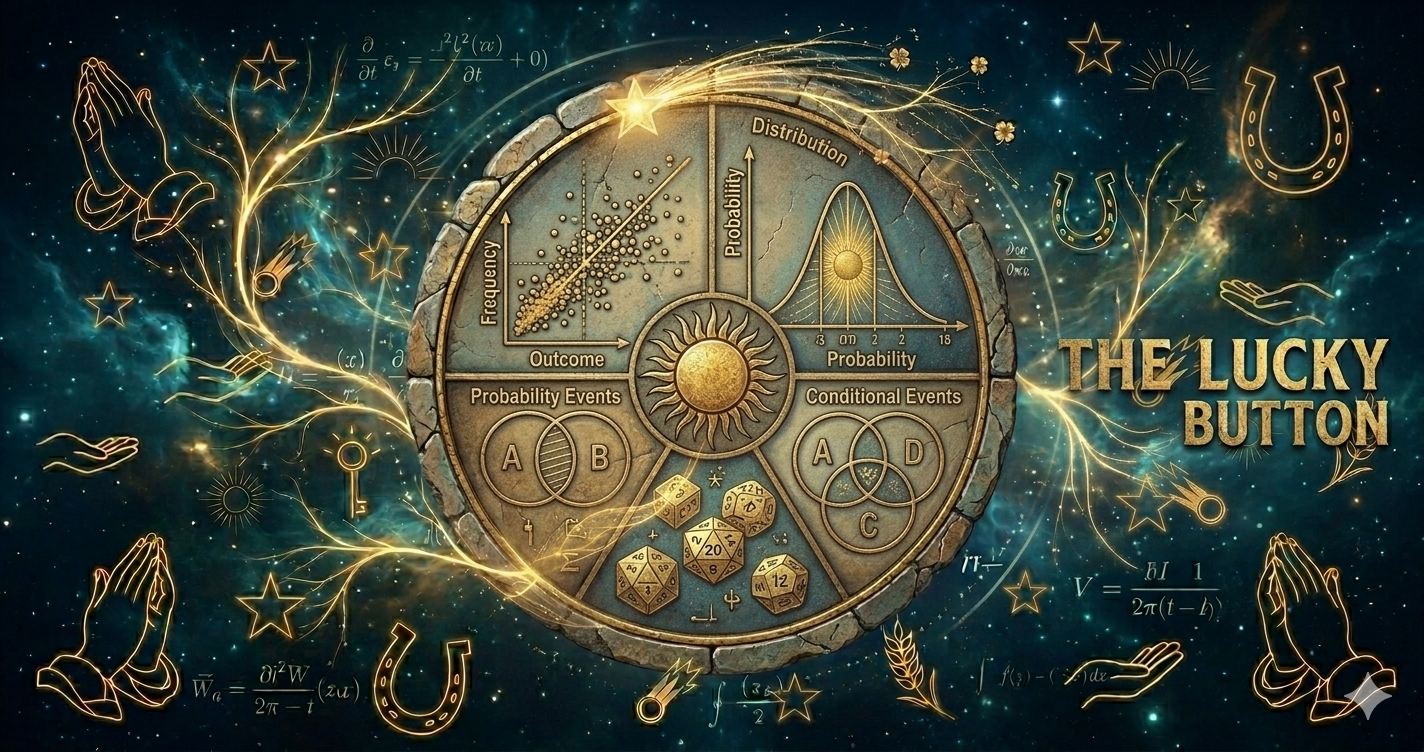
Mathematical visualization showing probability theory and statistics concepts with real-world applications, featuring charts, graphs, dice, and statistical formulas"

Developing Statistical Intuition

The most practically valuable skill is developing intuitive understanding of probability concepts that can be applied quickly in daily decisions:

🎯 Building Probability Intuition

  • Practice Estimation: Before looking up odds, estimate probabilities of various events
  • Track Predictions: Keep a log of your probability estimates and actual outcomes
  • Learn Common Base Rates: Memorize frequencies of common events (disease rates, accident probabilities, etc.)
  • Question Coincidences: When something seems remarkably lucky or unlucky, calculate actual probabilities
  • Understand Orders of Magnitude: Develop intuition for differences between 1 in 100, 1 in 1,000, and 1 in 1,000,000 events

Balancing Analysis with Action

While probability analysis provides valuable insights, it’s important to avoid “analysis paralysis.” The goal is making better decisions, not achieving perfect certainty. Mathematical thinking should enhance rather than replace judgment and action.

This balance connects to broader themes about how luck narratives shape our experiences and help us make sense of uncertainty and surprise in life.

Conclusion: Mathematics as a Lens for Understanding Luck

Probability and statistics don’t eliminate luck—they provide a mathematical language for understanding and working with uncertainty. This understanding reveals that many events we attribute to chance follow predictable patterns, while other occurrences are genuinely random and unpredictable.

The mathematics of luck teaches us several important lessons:

  • Rare events happen regularly: With billions of people experiencing millions of events, statistically unlikely occurrences are actually common
  • Patterns emerge from randomness: Random processes often produce structures that appear meaningful but are actually coincidental
  • Long-term trends matter more than short-term variation: Single events provide little information about underlying probabilities
  • Preparation meets opportunity: Understanding probabilities helps position yourself for favorable outcomes
  • Intuition needs calibration: Human probability estimation is systematically biased and benefits from mathematical thinking

Perhaps most importantly, understanding the mathematics behind luck helps maintain perspective during both fortunate and unfortunate periods. Extreme outcomes—both positive and negative—are natural features of probability distributions rather than indicators of cosmic favoritism or cosmic punishment.

This mathematical perspective doesn’t diminish the joy of positive surprises or the challenge of setbacks. Instead, it provides a framework for responding to both with appropriate calibration, better decision-making, and realistic expectations about the future.

The next time you experience what feels like remarkable luck—good or bad—consider the mathematical forces at work. You might find that understanding the probability doesn’t reduce the wonder; it adds another layer of appreciation for the complex and fascinating ways that mathematics shapes our experience of chance, choice, and possibility.

Ready to test your own luck against mathematical probability? Try our Lucky Button and see how your individual experience compares to statistical expectations!

📚 Research References:

  • Kahneman, D., & Tversky, A. (1979). “Prospect Theory: An Analysis of Decision under Risk.” Econometrica, 47(2), 263-291.
  • Gilovich, T., Vallone, R., & Tversky, A. (1985). “The hot hand in basketball: On the misperception of random sequences.” Cognitive Psychology, 17(3), 295-314.
  • Miller, J. B., & Sanjurjo, A. (2018). “Surprised by the hot hand fallacy? A truth in the law of small numbers.” Econometrica, 86(6), 2019-2047.
  • Feller, W. (1968). An Introduction to Probability Theory and Its Applications. John Wiley & Sons.
  • Malkiel, B. G. (2019). A Random Walk Down Wall Street. W. W. Norton & Company.
  • Wasserstein, R. L., & Lazar, N. A. (2016). “The ASA statement on p-values: Context, process, and purpose.” The American Statistician, 70(2), 129-133.
  • Thaler, R. H., & Sunstein, C. R. (2008). Nudge: Improving Decisions about Health, Wealth, and Happiness. Yale University Press.
  • Taleb, N. N. (2007). The Black Swan: The Impact of the Highly Improbable. Random House.
  • Silver, N. (2012). The Signal and the Noise: Why So Many Predictions Fail—But Some Don’t. Penguin Press.
  • Bernstein, P. L. (1996). Against the Gods: The Remarkable Story of Risk. John Wiley & Sons.

🏷️ Tags:

Probability Theory
Statistics
Mathematical Thinking
Gambler’s Fallacy
Statistical Significance
Normal Distribution
Bayes’ Theorem
Expected Value
Law of Large Numbers
Central Limit Theorem
Decision Making
Risk Assessment
Behavioral Economics
Casino Mathematics
Investment Analysis

🔗 Experience The Lucky Button

Try our original Lucky Button tool—a simple daily reminder to pause, breathe, and invite positive energy into your day.


Lucky Button - Your daily dose of positivity and mindfulness

Your Next Lucky Break Starts Here


Tell Us: What does luck mean to you?

Drop a comment below or hit the Lucky Button and start your journey today.