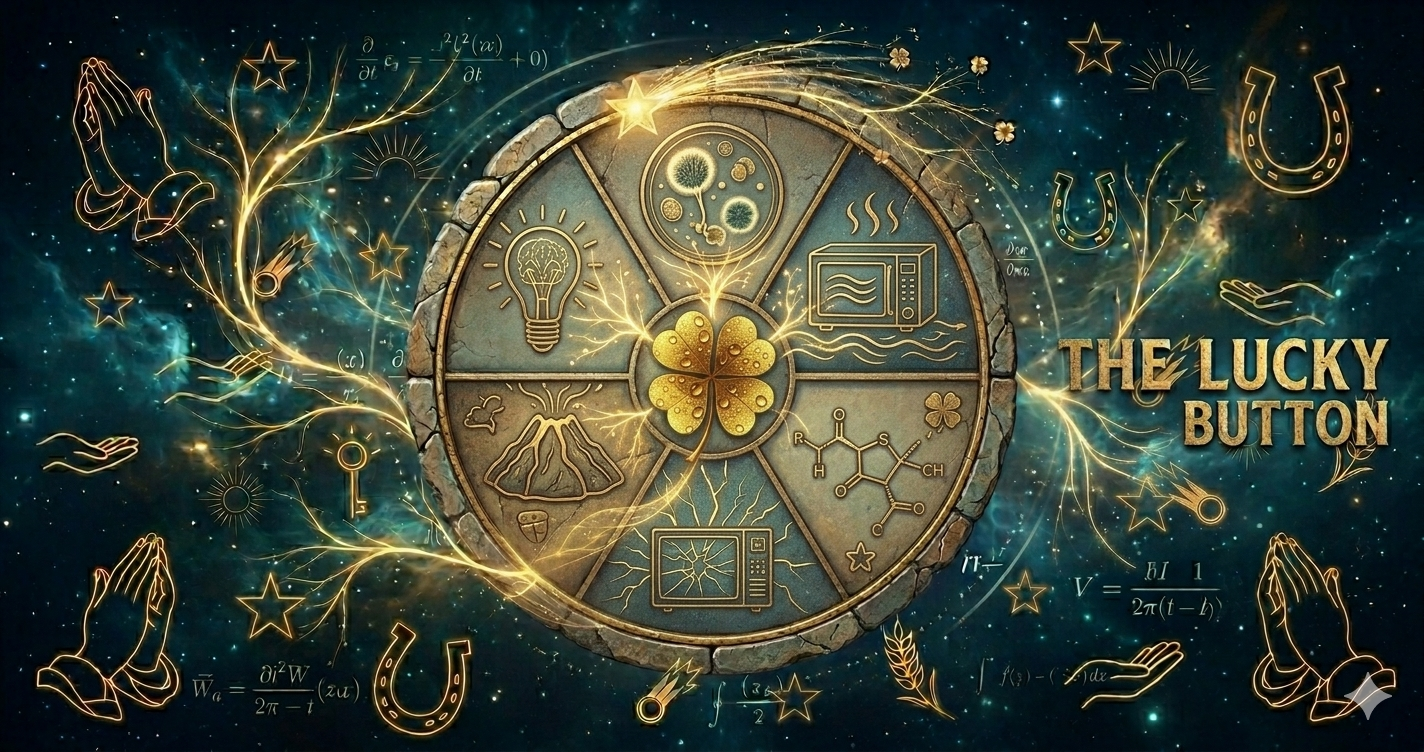
🌍 When Fortune Favors the Prepared Mind
Some of humanity's greatest discoveries weren't the result of careful planning, meticulous research proposals, or billion-dollar budgets. They were happy accidents — moments where curiosity collided with chance and changed the course of history.
But here's the critical insight: these "lucky" moments didn't happen to just anyone. As the French microbiologist Louis Pasteur famously observed, "Fortune favors the prepared mind." Every accidental discovery on this list required a person who was knowledgeable enough to recognize something unusual, curious enough to investigate further, and persistent enough to follow through.
The scientific term for this is serendipity — a word coined by Horace Walpole in 1754, inspired by the Persian fairy tale The Three Princes of Serendip, whose heroes "were always making discoveries, by accidents and sagacity, of things they were not in quest of."
Let's explore some of the most remarkable examples.
💊 Penicillin: The Mold That Saved Millions (1928)
In September 1928, Scottish bacteriologist Alexander Fleming returned to his laboratory at St. Mary's Hospital in London after a summer vacation. He found that a petri dish containing Staphylococcus bacteria had been accidentally contaminated by a mold — Penicillium notatum.
Rather than discarding the ruined experiment, Fleming noticed something remarkable: the bacteria immediately surrounding the mold had been killed, creating a clear ring of dead cells. He could have shrugged and cleaned up. Instead, he investigated.
Fleming's discovery of penicillin didn't immediately transform medicine — it took another decade of work by Howard Florey and Ernst Boris Chain at Oxford to develop it into a usable drug. But when mass-produced during World War II, penicillin saved countless lives from battlefield infections and earned all three scientists the Nobel Prize in Physiology or Medicine in 1945.
Today, antibiotics derived from Fleming's accidental observation have saved an estimated 200 million lives worldwide. One contaminated petri dish changed the trajectory of human health forever.
🍫 The Microwave Oven: A Melted Chocolate Bar (1945)
Percy Spencer was a self-taught engineer at the Raytheon Corporation, working on magnetrons — the devices that powered radar systems during World War II. One day in 1945, while standing near an active magnetron, he noticed something odd: a chocolate bar in his pocket had melted.
Most people would have simply been annoyed. Spencer was intrigued. He immediately began experimenting, first with popcorn kernels (they popped), then with an egg (it exploded in a colleague's face). Within months, Raytheon filed a patent for the first commercial microwave oven, the "Radarange," which debuted in 1947 standing nearly 6 feet tall and costing $5,000 (about $67,000 in today's dollars).
The countertop microwave as we know it didn't arrive until 1967. Today, over 90% of American households own one — all because an engineer paid attention to a melting chocolate bar.
📝 Post-it Notes: The Weak Adhesive That Stuck (1968–1980)
In 1968, Dr. Spencer Silver, a chemist at 3M, was attempting to develop a super-strong adhesive. He failed — spectacularly. What he produced instead was an adhesive so weak it could barely hold two pieces of paper together, yet it could be peeled off and reapplied without leaving residue.
Silver spent five years trying to find a use for his "useless" invention, presenting it at internal 3M seminars without success. Then, in 1974, his colleague Art Fry had a eureka moment during a church choir practice. His paper bookmarks kept falling out of his hymnal. He remembered Silver's weak adhesive and applied it to small strips of paper.
The Post-it Note was born — though it took until 1980 for 3M to launch the product nationally. Initial market tests were disappointing until 3M gave away free samples in Boise, Idaho. Once people tried them, they couldn't stop using them. Today, 3M sells over 50 billion Post-it Notes annually in more than 100 countries.
☢️ X-rays: The Invisible Light (1895)
On November 8, 1895, German physicist Wilhelm Conrad Roentgen was experimenting with cathode ray tubes in his darkened laboratory when he noticed something peculiar: a fluorescent screen several feet away was glowing, even though the tube was completely enclosed in thick black cardboard.
Roentgen realized he had discovered a new type of radiation capable of passing through solid objects. He spent the next several weeks obsessively investigating these mysterious rays, which he called "X-rays" (X representing the unknown). His first X-ray image was of his wife Anna Bertha's hand — when she saw the skeletal image of her own fingers, complete with her wedding ring, she reportedly exclaimed, "I have seen my death!"
Within months, X-rays were being used in hospitals worldwide. Roentgen received the first-ever Nobel Prize in Physics in 1901 and, notably, refused to patent his discovery, believing it should benefit all of humanity.
🔧 Vulcanized Rubber: A Fortunate Fumble (1839)
For years, American inventor Charles Goodyear was obsessed with making natural rubber commercially viable. Raw rubber was frustratingly impractical — it melted in summer heat and cracked in winter cold. Goodyear had already been imprisoned for debt and was living in poverty when, in 1839, he accidentally dropped a mixture of rubber and sulfur onto a hot stove.
Instead of melting into a gooey mess as expected, the rubber charred and hardened. Goodyear immediately recognized that heat and sulfur had transformed the material into something durable, flexible, and weather-resistant. He called the process "vulcanization" (after Vulcan, the Roman god of fire).
Vulcanized rubber went on to become one of the most important industrial materials in history, essential for tires, seals, hoses, and countless other products. Sadly, Goodyear died in 1860, deeply in debt despite his revolutionary discovery. The Goodyear Tire Company, founded 38 years after his death, was named in his honor.
🧪 More Lucky Accidents That Changed Everything
The list extends far beyond these famous examples:
- Teflon (1938): Roy Plunkett at DuPont discovered polytetrafluoroethylene (PTFE) when an experiment with refrigerant gases produced a slippery white substance instead of the expected result. Non-stick cookware and countless industrial applications followed.
- Safety Glass (1903): French chemist Edouard Benedictus accidentally knocked a glass flask off his shelf. It shattered but didn't break apart — the interior had been coated with a dried plastic solution. His observation led to laminated safety glass, now standard in car windshields.
- Saccharin (1879): Chemist Constantine Fahlberg forgot to wash his hands after a day in the lab and noticed his dinner tasted unusually sweet. Tracing the sweetness back to a compound he'd been working with, he discovered the first artificial sweetener.
- Velcro (1941): Swiss engineer George de Mestral returned from a hike covered in burdock burrs. Under a microscope, he saw tiny hooks on the burrs that gripped fabric loops — inspiring the hook-and-loop fastener we now call Velcro.
🔬 The Science of Serendipity
Researchers at the University of Bath have studied the conditions that foster serendipitous discoveries. Their findings suggest that serendipity isn't purely random — it's influenced by several factors:
1. Broad Knowledge Base: Scientists who read widely across disciplines are more likely to recognize the significance of unexpected results.
2. Tolerance for Ambiguity: Those comfortable with uncertainty are less likely to discard anomalous findings as errors.
3. Collaborative Environments: Diverse teams bring different perspectives, increasing the chance that someone will see the significance of an unexpected result.
4. Persistence: Many serendipitous discoveries required years of follow-up work to develop the initial accident into a useful innovation.
As Dr. Pek van Andel, who has cataloged over 1,000 cases of scientific serendipity, puts it: "Serendipity is looking in a haystack for a needle and discovering a farmer's daughter."
✨ The Common Thread: Preparation Meets Opportunity
Every story on this list shares something profound: the accident alone wasn't enough. Millions of people have seen mold growing on food, melted chocolate in their pockets, or found burrs stuck to their clothing. What separated Fleming, Spencer, and de Mestral from everyone else was their prepared minds — their knowledge, curiosity, and willingness to pursue the unexpected.
This is perhaps the most empowering lesson from the history of lucky accidents: you can't control when serendipity strikes, but you can control how prepared you are to recognize it and how courageously you pursue it.
"In the fields of observation, chance favors only the prepared mind." — Louis Pasteur
💬 Over to You
What's the luckiest "accident" you've ever experienced? A wrong turn that led you somewhere wonderful? A mistake that became your biggest success? Share your serendipity story in the comments — and explore more fascinating tales of fortune on The Lucky Button Blog.
📚 References & Further Reading
- Serendipity: Accidental Discoveries in Science — Royston M. Roberts (1989)
- Happy Accidents: Serendipity in Modern Medical Breakthroughs — Morton Meyers (2007)
- Alexander Fleming and the Discovery of Penicillin — American Chemical Society (1999)
Lucky Button Team
Educators & Probability Researchers
A multidisciplinary team of psychology graduates, data scientists, and educators dedicated to making the science of luck accessible and fun.
Learn more about our team →Join the Conversation
Tell Us: What does luck mean to you?
Loading comments...