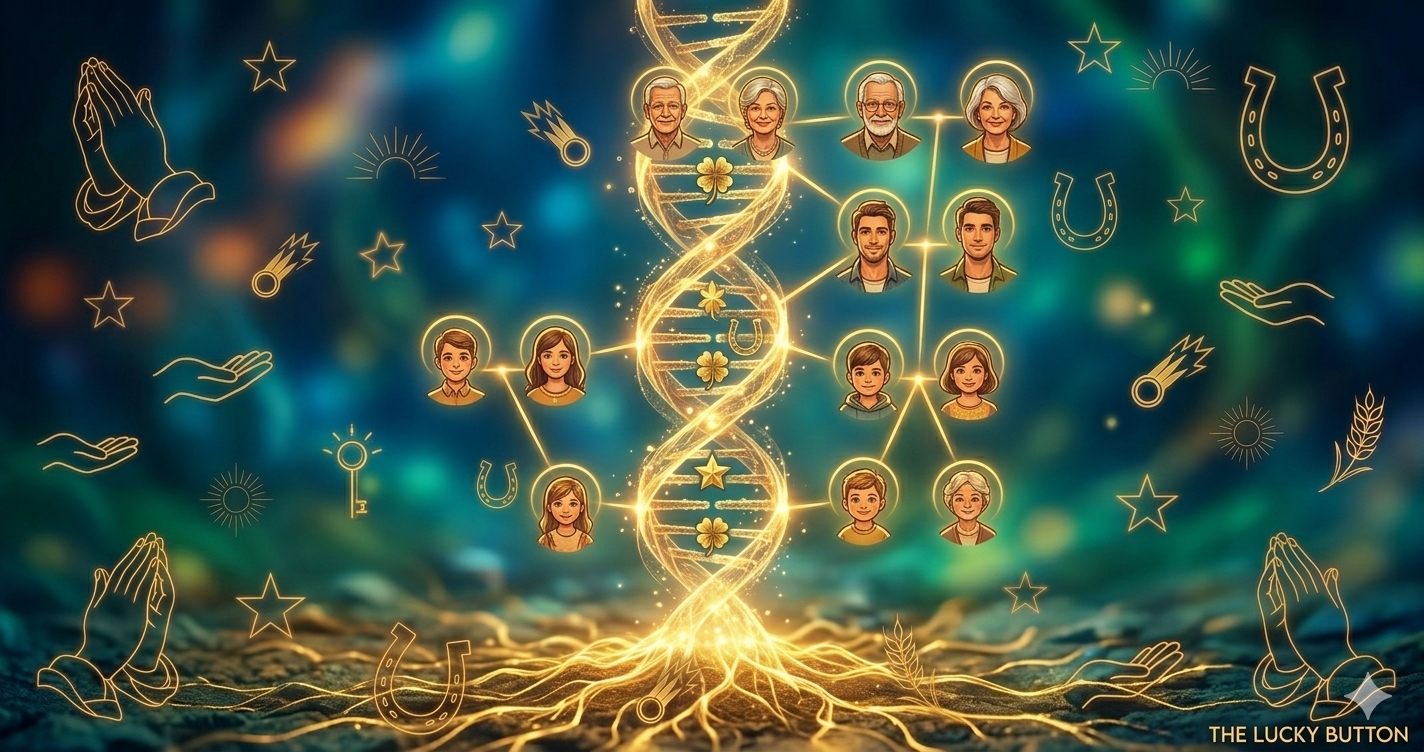
Nature, Nurture, and Fortune
Is luck something you are born with? The question sounds like superstition, but modern genetics offers a surprisingly nuanced answer. While no one inherits "luck" directly, we do inherit genes that influence personality traits, cognitive styles, and neurochemical systems that collectively shape how we perceive, create, and respond to fortunate events. The genetics of luck is really the genetics of the psychological machinery that produces the experience of fortune.
---
The DRD4 Gene: Born to Explore
One of the most studied genes in behavioral genetics is DRD4, which codes for a type of dopamine receptor in the brain. The gene comes in several variants (alleles), distinguished by the number of times a particular DNA sequence is repeated. The 7-repeat allele (7R) has attracted particular attention because of its association with novelty-seeking behavior.
Research published in Nature Genetics by Richard Ebstein and colleagues in 1996 first established the link between DRD4-7R and novelty seeking. Subsequent studies, including a large meta-analysis by Munaf and colleagues published in Molecular Psychiatry in 2008, confirmed that carriers of the 7R allele score significantly higher on personality measures of exploration, risk-taking, and openness to new experiences.
From a luck perspective, this is significant. Richard Wiseman's research established that lucky people are characterized by their willingness to try new things, explore unfamiliar situations, and take calculated risks. If the DRD4-7R allele predisposes people toward these behaviors, it may indirectly predispose them toward experiencing more fortunate outcomes -- not through magic, but through increased exposure to opportunity.
The 7R allele is not universally distributed. Its frequency varies dramatically across populations, from less than 10% in East Asian populations to nearly 70% in some South American indigenous groups. Some researchers, notably Chuansheng Chen and colleagues at UC Irvine, have proposed that the allele was positively selected in populations with histories of long-distance migration -- suggesting that the genetic basis for exploration and risk-taking has been shaped by tens of thousands of years of evolutionary pressure.
---
The Serotonin Transporter Gene: Wired for Optimism
The serotonin transporter gene (5-HTTLPR) influences how efficiently serotonin -- a neurotransmitter critical for mood regulation -- is recycled in the brain. The gene comes in two main variants: a short allele associated with higher emotional reactivity and a long allele associated with greater emotional resilience and optimism.
A landmark study by Avshalom Caspi and colleagues, published in Science in 2003, found that individuals carrying two copies of the long allele were significantly more resilient in the face of stressful life events and less likely to develop depression. Subsequent research by Elaine Fox at the University of Oxford demonstrated that long-allele carriers show an attentional bias toward positive information -- they literally look at the bright side more readily at an unconscious, automatic level.
This connects directly to luck perception. Wiseman's four principles of lucky people include "expect good fortune" and "turn bad luck into good" -- both of which depend on optimistic cognitive styles. If the 5-HTTLPR long allele promotes automatic optimism and positive attentional bias, carriers may be neurobiologically predisposed to interpret ambiguous events favorably and maintain the positive expectations that characterize self-identified lucky people.
It is important to note that the 5-HTTLPR findings have been subject to ongoing debate. A large 2019 study by Border and colleagues, published in the American Journal of Psychiatry, failed to replicate the gene-by-environment interaction for depression. However, Fox's work on attentional bias -- which measures a more specific cognitive mechanism than broad depression outcomes -- has been more consistently supported.
---
Twin Studies: Measuring the Heritability of Luck
The most direct way to estimate genetic influence on any trait is through twin studies, which compare identical twins (who share 100% of their genes) with fraternal twins (who share approximately 50%). If identical twins are more similar on a trait than fraternal twins, the difference is attributable to genetic factors.
While no large-scale twin study has directly measured "luck" as a trait, several have examined closely related constructs:
Optimism and subjective well-being: A study by Nes and colleagues, published in Behavior Genetics in 2006, estimated the heritability of optimism at approximately 25%, with the remaining variance attributable to environmental factors and measurement error. A larger meta-analysis by Bartels and Boomsma (2009) estimated the heritability of subjective well-being -- closely related to feelings of being fortunate -- at approximately 36-50%.
Risk-taking and sensation-seeking: Twin studies consistently estimate the heritability of sensation-seeking at approximately 60%, making it one of the most heritable personality traits. This is relevant because risk-taking and novelty-seeking are core behavioral components of the "lucky" personality profile.
Openness to experience: The Big Five personality dimension most strongly associated with self-reported luck has an estimated heritability of 57%, according to a meta-analysis by Vukasovic and Bratko published in Psychological Bulletin in 2015.
Taken together, these studies suggest that approximately 40-60% of the personality traits associated with luck perception have a genetic basis. This does not mean luck itself is genetic -- it means the psychological precursors to lucky behavior are substantially influenced by inherited factors.
---
Epigenetics: Where Nature Meets Nurture
The nature-versus-nurture debate has been transformed by the discovery of epigenetics -- mechanisms by which environmental experiences can alter gene expression without changing the DNA sequence itself. Epigenetic modifications include DNA methylation and histone modification, which can activate or silence genes in response to environmental signals.
This is directly relevant to the genetics of luck because it means that even genetically inherited traits are not fixed. Key findings include:
Early life experience shapes gene expression. Research by Michael Meaney at McGill University demonstrated that the quality of maternal care in rats permanently altered the epigenetic regulation of stress-response genes. Pups that received more nurturing showed lasting epigenetic changes that made them calmer, more exploratory, and more resilient -- all traits associated with lucky behavior. Similar patterns have been observed in human studies of childhood adversity and nurturing.
Stress exposure modifies serotonin-related genes. Epigenetic studies have shown that chronic stress can alter the methylation patterns of serotonin-related genes, shifting individuals toward more anxious, pessimistic cognitive styles. Conversely, positive experiences and therapeutic interventions can partially reverse these epigenetic marks.
Enriched environments enhance cognitive flexibility. Animal studies consistently show that enriched environments -- those providing novelty, social interaction, and cognitive challenge -- produce epigenetic changes that enhance neuroplasticity, learning, and exploratory behavior. These are precisely the cognitive qualities that Wiseman identified in his "lucky" research subjects.
The epigenetic perspective suggests a more nuanced model of luck than either pure genetics or pure environment. Your genes provide a starting palette of tendencies -- toward optimism or pessimism, exploration or caution, resilience or fragility. Your experiences then modify how those genes are expressed, amplifying some tendencies and dampening others. The result is a continuously evolving psychological profile that shapes your relationship with fortune.
---
The Interplay: A Model of Inherited Fortune
Synthesizing the genetic research, we can propose a model of how fortune "runs in families" -- not through mystical inheritance, but through documented biological and environmental pathways:
1. Genetic predisposition (approximately 40-60%): Variants in genes like DRD4, 5-HTTLPR, and many others collectively influence temperament, cognitive style, and neurochemical balance in ways that affect opportunity detection, risk-taking, optimism, and social engagement.
2. Shared environment (approximately 10-20%): Families share not just genes but environments -- socioeconomic conditions, cultural practices, social networks, and parenting styles that shape the development of luck-related behaviors.
3. Epigenetic transmission: Some epigenetic marks can be passed across generations, meaning that a grandparent's experiences of abundance or scarcity could subtly influence a grandchild's stress response and cognitive style.
4. Cultural and behavioral inheritance: Lucky families may transmit not just genes but habits, mindsets, and social connections that increase fortune -- a form of "luck culture" passed down through modeling and teaching.
---
What This Means for You
The genetics of luck carries both a humbling and an empowering message.
The humbling message: Your starting point is not entirely under your control. Genetic factors genuinely influence the personality traits and cognitive styles that shape luck perception. Some people begin life with neurobiological advantages in optimism, exploration, and resilience.
The empowering message: Genetics is not destiny. Epigenetics demonstrates that gene expression is plastic and responsive to experience. The personality traits associated with luck -- openness, optimism, social engagement, resilience -- can all be cultivated through deliberate practice, environmental design, and therapeutic intervention, regardless of your genetic starting point.
You may not choose your genes, but you can choose your environment, your habits, and your mindset. And the science increasingly suggests that those choices matter at least as much as your DNA in determining how lucky you feel -- and how lucky you become.
📚 References & Further Reading
- Dopamine D4 Receptor (DRD4) Exon III Polymorphism Associated with the Human Personality Trait of Novelty Seeking — Richard Ebstein et al., Nature Genetics (1996)
- Influence of Life Stress on Depression: Moderation by a Polymorphism in the 5-HTT Gene — Avshalom Caspi et al., Science (2003)
- Rainy Brain, Sunny Brain: The New Science of Optimism and Pessimism — Elaine Fox, Oxford University (2012)
- Heritability of Life Satisfaction and Subjective Well-Being — Bartels and Boomsma, Behavior Genetics (2009)
- Epigenetic Programming by Maternal Behavior — Michael Meaney et al., Nature Neuroscience (2004)
- Heritability of the Big Five Personality Dimensions — Vukasovic and Bratko, Psychological Bulletin (2015)
Lucky Button Team
Educators & Probability Researchers
A multidisciplinary team of psychology graduates, data scientists, and educators dedicated to making the science of luck accessible and fun.
Learn more about our team →Join the Conversation
Tell Us: What does luck mean to you?
Loading comments...