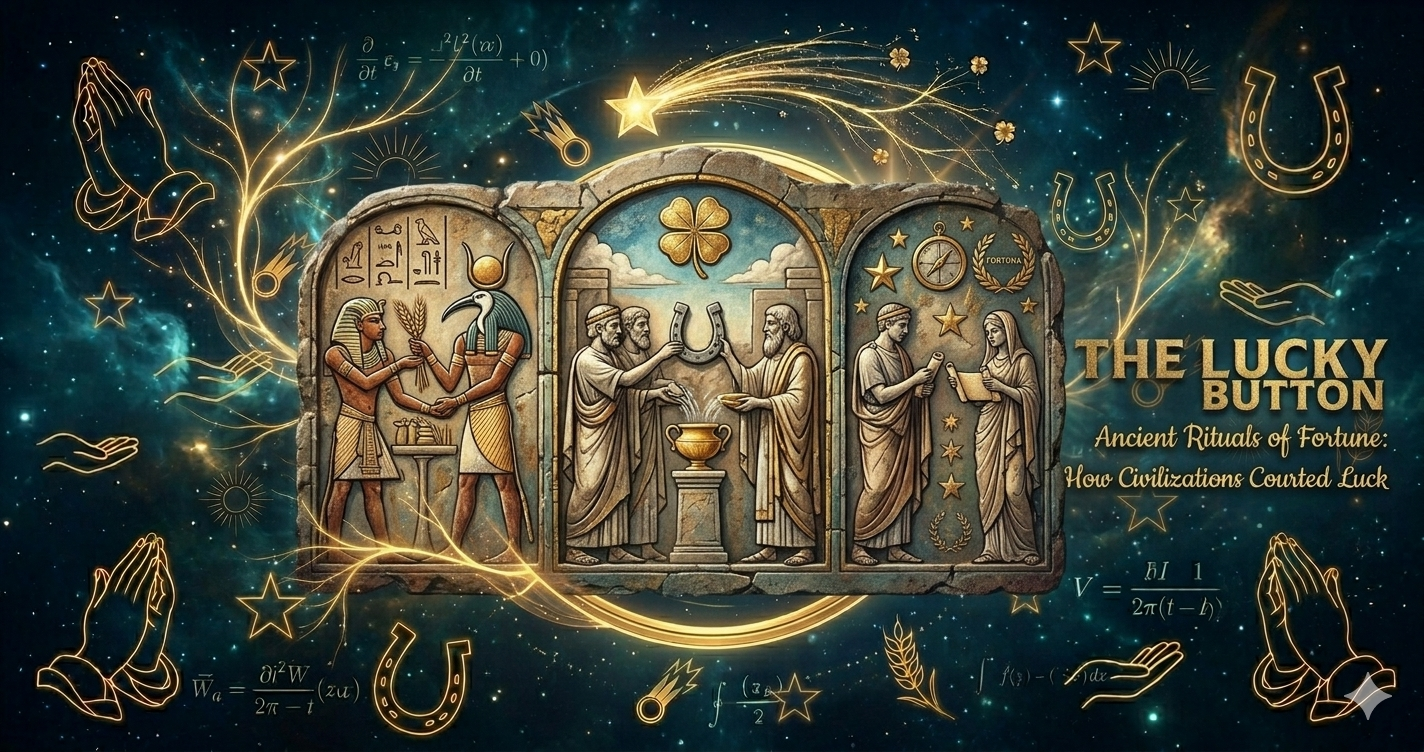
Humanity's Oldest Quest: Controlling Fate
Long before probability theory or neuroscience, humans sought to understand and influence the forces of fortune. Every major civilization developed its own rituals, objects, and systems for courting luck -- and remarkably, many of these practices persist in modified forms today. The history of luck rituals is, in many ways, the history of human psychology itself: our deep need to find patterns in chaos and exert control over the uncontrollable.
---
Roman Divination and Augury
In ancient Rome, no major decision -- military, political, or personal -- was made without first consulting the will of the gods through divination. The most prestigious form was augury, the practice of interpreting the flight patterns, songs, and feeding behaviors of birds.
Augurs were among the most powerful officials in the Roman Republic. They did not predict the future directly; instead, they determined whether the gods approved or disapproved of a proposed action. Before a battle, a general would release sacred chickens. If the birds ate eagerly, it was a favorable omen (tripudium solistimum). If they refused to eat, the action should be postponed.
The practice was taken with deadly seriousness. In 249 BCE, the consul Publius Claudius Pulcher threw the sacred chickens overboard when they refused to eat before a naval battle, reportedly saying, "If they won't eat, let them drink." He lost the Battle of Drepana catastrophically and was later tried for impiety.
Roman augury was codified in the Augural Books, a collection of sacred texts maintained by the College of Augurs. The system persisted for over 700 years, demonstrating how deeply the need for perceived control over fortune was woven into Roman society and governance. Historian Mary Beard has noted that augury functioned less as genuine fortune-telling and more as a mechanism for political legitimacy -- a way to sanctify decisions already made.
---
Chinese Feng Shui: Engineering Fortune Through Space
Feng shui (literally "wind-water") originated over 3,500 years ago during the Shang Dynasty and remains one of the most enduring systems for attracting good fortune ever devised. Unlike Western approaches to luck, which often focus on individual actions or objects, feng shui treats fortune as a property of spatial arrangement -- something that flows through environments and can be directed, blocked, or amplified.
The foundational concept is qi (chi) -- a vital life force that flows through all things. Feng shui practitioners analyze how qi moves through a space using tools like the luopan (a magnetic compass with concentric rings of data) and the bagua (an octagonal map that divides space into eight life areas: wealth, fame, love, family, health, creativity, knowledge, and career).
The system's origins lie in burial practices. Early feng shui masters selected grave sites to ensure that the deceased's qi would benefit living descendants. Over centuries, the practice expanded to encompass the design of homes, temples, cities, and eventually modern office buildings.
Key principles include the balance of yin and yang (passive and active energies), the productive and destructive cycles of the Five Elements (wood, fire, earth, metal, water), and the careful management of "poison arrows" -- sharp angles or straight lines that accelerate qi into harmful patterns.
Modern feng shui has been dismissed by many scientists as pseudoscience, but research in environmental psychology provides interesting parallels. Studies have shown that spatial arrangement genuinely affects mood, productivity, and cognitive function -- suggesting that feng shui, whatever its metaphysical claims, may encode real psychological insights about the relationship between environment and well-being.
---
Egyptian Amulets: The Scarab Beetle and the Sun
Ancient Egyptians were perhaps the most prolific producers of luck charms in the ancient world. They crafted amulets from precious stones, faience, and metals, each designed to attract specific forms of fortune or ward off particular evils.
The scarab beetle (Scarabaeus sacer) was the supreme symbol of luck and renewal. Egyptians observed the beetle rolling balls of dung across the ground and associated this behavior with the god Khepri, who was believed to roll the sun across the sky each day. The scarab thus represented transformation, rebirth, and the eternal renewal of life.
Scarab amulets were ubiquitous. They were worn as jewelry, placed over the hearts of the deceased during mummification (as heart scarabs inscribed with spells from the Book of the Dead), and used as official seals. Pharaohs issued commemorative scarabs to mark great events -- a practice that combined administrative function with talismanic power.
Other major Egyptian luck amulets included the Eye of Horus (wadjet), believed to provide protection and healing; the ankh, symbolizing eternal life; and the djed pillar, representing stability and the backbone of the god Osiris. Archaeological evidence from sites across Egypt, compiled by researchers like Carol Andrews of the British Museum, demonstrates that amulet use crossed all social classes, from pharaohs to farmers.
---
The Oracle at Delphi: Greece's Gateway to Fortune
For over a thousand years, the Oracle at Delphi was the most important religious institution in the ancient Greek world. Located on the slopes of Mount Parnassus, the sanctuary of Apollo at Delphi was believed to be the center of the world -- the spot where two eagles released by Zeus from opposite ends of the earth met.
At the heart of the Oracle was the Pythia, a priestess who entered a trance state and delivered prophecies in response to questions from individuals and city-states alike. Before major military campaigns, colonial expeditions, or political decisions, leaders traveled to Delphi to seek the god's guidance.
The Pythia's pronouncements were famously ambiguous. When King Croesus of Lydia asked whether he should attack Persia, the Oracle replied that if he did, "a great empire would fall." Croesus attacked -- and the great empire that fell was his own. This ambiguity was not a bug but a feature: it allowed the Oracle to maintain credibility regardless of outcomes.
Modern archaeological and geological research has suggested that the Pythia's trance states may have had a physical basis. Studies by geologist Jelle de Boer and archaeologist John Hale, published in Geology and Scientific American, found that the temple sat above geological fault lines that released ethylene and other hydrocarbon gases -- substances known to produce euphoria, altered consciousness, and trance-like states when inhaled.
---
Norse Rune Casting: Reading Fate in Stone
The Norse and Germanic peoples developed rune casting as a system for divining fate and attracting fortune. Runes were not merely an alphabet -- they were considered sacred symbols, each carrying specific magical properties and connections to cosmic forces.
According to Norse mythology, the god Odin discovered the runes after hanging from the world-tree Yggdrasil for nine days and nights, pierced by his own spear, in a sacrifice of himself to himself. This origin story emphasizes that knowledge of fate comes only through suffering and sacrifice.
In practice, rune casting involved carving runic symbols onto small pieces of wood, bone, or stone, then casting them onto a cloth and interpreting the patterns. The Roman historian Tacitus, writing in Germania (98 CE), described the practice: the caster would scatter the pieces, pick up three at random while looking skyward, and interpret them according to established meanings.
Each of the 24 runes of the Elder Futhark carried specific associations. Fehu represented wealth and prosperity. Uruz symbolized strength and vitality. Kenaz represented knowledge and creativity. The interpretation of rune casts depended on which runes appeared, their orientation (upright or reversed), and their positions relative to one another.
---
Japanese Maneki-neko: The Beckoning Cat
The Maneki-neko (beckoning cat) is one of the most recognizable luck symbols in East Asia, found in the windows of shops, restaurants, and homes throughout Japan, China, and increasingly the Western world. The figurine depicts a cat with one paw raised in a beckoning gesture.
The most popular origin story dates to the Edo period (1603-1868) and involves the Gotokuji Temple in Tokyo. According to legend, a feudal lord named Ii Naotaka was passing the temple during a thunderstorm when he noticed a cat at the gate, apparently beckoning him inside. He followed the cat, and moments later, lightning struck the exact spot where he had been standing. In gratitude, the lord became the temple's patron, ensuring its prosperity.
The symbolism of the Maneki-neko is specific and layered:
- Left paw raised: Attracts customers and people
- Right paw raised: Attracts money and good fortune
- Color matters: Calico for overall luck, white for purity, black for warding off evil, gold for wealth, red for health
- Height of the raised paw: The higher the paw, the greater the fortune it attracts from afar
---
The Thread That Connects Them All
Across every culture and era, luck rituals share common psychological foundations. They provide a sense of agency in the face of uncertainty. They create community bonds through shared belief and practice. They offer frameworks for decision-making when information is incomplete.
Modern psychology recognizes these functions. Research on illusory control -- the belief that we can influence random outcomes -- shows that such beliefs, while factually incorrect, can provide genuine psychological benefits: reduced anxiety, increased confidence, and greater persistence in the face of setbacks. A 2010 study published in Psychological Science by Lysann Damisch and colleagues found that participants who were told they had a "lucky" golf ball performed significantly better than those with a regular ball -- suggesting that luck beliefs can function as performance-enhancing placebos.
The ancient rituals of fortune may not have worked the way their practitioners believed. But in harnessing the power of belief, expectation, and community, they tapped into something profoundly real about human psychology. In that sense, the ancients understood luck better than they knew.
📚 References & Further Reading
- The Religion of the Romans — Jorg Rupke (2007)
- The Living Great Mother: Feng Shui Origins — Stephen Feuchtwang (2002)
- Amulets of Ancient Egypt — Carol Andrews, British Museum (1994)
- The Oracle: The Lost Secrets and Hidden Message of Ancient Delphi — William Broad (2006)
- Geology and the Oracle at Delphi — Jelle de Boer, John Hale (2001)
- Keep Your Fingers Crossed! How Superstition Improves Performance — Lysann Damisch et al., Psychological Science (2010)
Lucky Button Team
Educators & Probability Researchers
A multidisciplinary team of psychology graduates, data scientists, and educators dedicated to making the science of luck accessible and fun.
Learn more about our team →Join the Conversation
Tell Us: What does luck mean to you?
Loading comments...