
📋 Table of Contents
- Our Educational Philosophy: Where Research Meets Accessibility
- Comprehensive Content Areas: A Multidisciplinary Exploration
- The Psychology Behind Luck: Core Research Foundations
- Historical Perspectives: The Evolution of Luck Concepts
- Cultural Diversity in Luck Beliefs: A Global Perspective
- The Science of Serendipity: Modern Research Insights
- Educational Goals and Learning Outcomes
- Research Methodology and Academic Standards
- Interactive Learning: Connecting Theory with Experience
- Community and Engagement: Building a Learning Network
- Content Navigation and Learning Pathways
- Continuous Learning and Content Evolution
- Academic Partnerships and Collaborations
- Conclusion: Your Intellectual Journey Begins
–>
The Lucky Button Blog represents far more than a collection of articles—it’s a comprehensive educational ecosystem designed to satisfy the deepest questions about human psychology, cultural diversity, historical development, and the scientific understanding of chance and probability. Whether you’re a psychology enthusiast, a history buff, a cultural studies student, or simply someone who enjoys learning about the quirky and profound aspects of human behavior, you’ve found your new intellectual home.
Our mission extends beyond surface-level entertainment to provide substantive, research-based content that meets the highest academic standards while remaining accessible and engaging for learners of all backgrounds.
Our Educational Philosophy: Where Research Meets Accessibility
At the heart of The Lucky Button Blog lies a fundamental belief: complex academic concepts can be presented in engaging, accessible ways without sacrificing intellectual rigor. Our approach combines evidence-based pedagogical practices with innovative digital learning experiences to create content that is both educationally valuable and genuinely enjoyable.
🎓 Our Core Educational Principles
Research-Based Content
Every article draws from peer-reviewed academic sources, ensuring accuracy and credibility. We regularly consult journals in psychology, anthropology, neuroscience, and cultural studies to provide current, reliable information.
Interdisciplinary Approach
Understanding luck requires insights from multiple fields. We integrate perspectives from cognitive psychology, cultural anthropology, historical analysis, statistical science, and behavioral economics to provide comprehensive understanding.
Interactive Learning Integration
Our unique platform connects theoretical knowledge with experiential learning through the Lucky Button interface, allowing readers to immediately apply and test concepts they’ve learned.
Cultural Sensitivity and Inclusivity
We approach cultural differences in luck beliefs with respect and scholarly rigor, avoiding Western-centric interpretations while maintaining objective analysis.
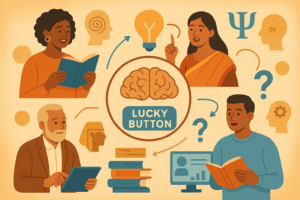
Academic Standards and Quality Assurance
Our commitment to educational excellence is demonstrated through rigorous content standards:
📚 Content Development Process
- Source Verification: All claims are supported by credible academic sources
- Expert Review: Content undergoes review by subject matter experts
- Fact-Checking: Multiple verification processes ensure accuracy
- Regular Updates: Content is updated as new research emerges
- Citation Standards: Academic-level referencing for all major claims
This approach ensures that our blog meets university-level educational standards while remaining accessible to general audiences. We believe that high-quality education should be available to anyone with curiosity and interest in learning.
Comprehensive Content Areas: A Multidisciplinary Exploration
Our blog covers an extensive range of academic disciplines and research areas, all unified by their relationship to understanding luck, chance, and human behavior in various contexts.
Cognitive Psychology & Neuroscience
Explore how our brains process random events, create patterns from chaos, and develop beliefs about fortune and misfortune. Learn about cognitive biases, pattern recognition, and the neurological basis of luck perception.
Featured Topics: Confirmation bias, pattern recognition, reward processing, decision-making under uncertainty
Cultural Anthropology & Sociology
Discover how different societies understand and interpret luck, fortune, and chance. Examine lucky symbols, superstitions, and beliefs across diverse cultures and their social functions.
Featured Topics: Cross-cultural luck beliefs, ritual practices, social functions of superstition, cultural transmission of beliefs
Historical Analysis & Development
Trace how concepts of luck have evolved throughout human civilization, from ancient divination practices to modern probability theory and statistical analysis.
Featured Topics: Ancient fortune-telling, medieval superstitions, development of probability theory, gambling history
Statistical Science & Probability
Understand the mathematics behind chance events, probability distributions, and statistical analysis. Learn how mathematical thinking reveals patterns in apparent randomness.
Featured Topics: Probability theory, statistical significance, random distributions, mathematical modeling
Behavioral Economics & Decision Making
Examine how luck beliefs influence economic choices, risk assessment, and financial decision-making. Explore the psychology of gambling, investment, and economic behavior.
Featured Topics: Risk perception, loss aversion, gambling psychology, investment behavior
Positive Psychology & Well-being
Investigate the role of optimism, gratitude, and positive thinking in creating favorable outcomes and improved life satisfaction.
Featured Topics: Optimism research, resilience building, mindset psychology, well-being factors
The Psychology Behind Luck: Core Research Foundations
Understanding luck perception provides crucial insights into fundamental aspects of human psychology and cognition. Research by leading psychologists has revealed that people who consider themselves “lucky” actually create more opportunities for positive outcomes through specific attitudes and behaviors.
Foundational Research: The Luck Factor
Dr. Richard Wiseman’s groundbreaking research at the University of Hertfordshire demonstrated that luck isn’t merely random chance—it’s significantly influenced by psychological factors including attention patterns, social behavior, and interpretation of events.
🔬 Key Research Findings
Attention and Opportunity Recognition: Lucky people maintain broader attentional focus, allowing them to notice unexpected opportunities that others miss.
Social Network Effects: Individuals who feel lucky tend to have more diverse social connections, increasing exposure to chance encounters and opportunities.
Resilience and Reframing: Lucky people demonstrate superior ability to find positive aspects in negative situations and learn from setbacks.
Intuition and Decision-Making: Research subjects who identified as lucky showed greater trust in intuitive decision-making processes.
Cognitive Biases and Pattern Recognition
Human brains are evolutionary wired to detect patterns, even in random events. This tendency, while sometimes leading to superstitious thinking, also provides crucial survival advantages in navigating complex social situations and making rapid decisions under uncertainty.
Our blog explores these cognitive mechanisms through multiple lenses:
- Confirmation Bias: How we selectively notice evidence supporting existing beliefs
- Availability Heuristic: The tendency to judge probability based on memorable examples
- Clustering Illusion: Seeing patterns in random sequences
- Attribution Theory: How we explain the causes of positive and negative events
Understanding these mechanisms helps readers develop more accurate probability assessments and make better decisions in uncertain situations. This connects directly to our comprehensive coverage of probability and statistics in everyday decision-making.
The Placebo Effect of Lucky Charms and Rituals
Scientific studies have demonstrated that lucky charms and rituals can genuinely improve performance through psychological mechanisms including increased confidence, reduced anxiety, and enhanced focus. Research published in Psychological Science shows measurable performance improvements when participants use objects they believe to be lucky.
These findings aren’t attributable to supernatural forces—they demonstrate psychology in action. Our educational content helps readers understand these mechanisms and potentially harness them for personal benefit while maintaining critical thinking about causation versus correlation.
Historical Perspectives: The Evolution of Luck Concepts
Humanity’s relationship with luck, fortune, and chance extends back to our earliest civilizations. Archaeological evidence and historical documentation reveal that virtually every human society has developed sophisticated systems for understanding, interpreting, and attempting to influence random events.
Ancient Civilizations and Fortune Systems
From Mesopotamian dice games dating back 5,000 years to Chinese I Ching divination systems, human societies have consistently sought to understand and control uncertain outcomes.
🏛️ Ancient Fortune Practices
Mesopotamian Traditions: Archaeological evidence reveals sophisticated dice games and divination practices in ancient Babylon and Assyria, demonstrating early mathematical understanding of probability.
Greek Oracle Systems: The Oracle at Delphi and other divination practices served important social and political functions beyond religious significance.
Roman Augury: Complex systems for interpreting bird flight patterns and natural phenomena influenced major political and military decisions.
Chinese Divination: The I Ching and other systems developed sophisticated philosophical frameworks for understanding change and uncertainty.
Medieval Superstitions and Social Functions
Many superstitions we consider quaint today actually served important psychological and social functions in medieval society. Our historical analysis examines how beliefs about black cats, broken mirrors, and walking under ladders originated and why they persist in modern times.
These beliefs weren’t simply primitive thinking—they often represented practical wisdom encoded in memorable cultural forms. For example, avoiding walking under ladders had genuine safety benefits, while beliefs about black cats related to their association with independent women who challenged social hierarchies.
The Scientific Revolution and Probability Theory
The mathematical understanding of probability emerged relatively recently in human history, primarily during the Renaissance and Enlightenment periods. The development of probability theory began with gambling problems in 17th-century France and evolved into sophisticated statistical methods underlying modern science and technology.
This historical progression reveals how human understanding of chance evolved from supernatural explanations to mathematical models, though psychological and cultural factors remain relevant in contemporary society. Our articles trace this fascinating evolution and its implications for modern decision-making.
Cultural Diversity in Luck Beliefs: A Global Perspective
One of the most intellectually rewarding aspects of studying luck is examining how different cultures interpret fortune, misfortune, and chance events. These cultural variations reveal fundamental differences in worldview, values, and social organization.
Eastern vs. Western Philosophical Frameworks
While Western cultures often conceptualize luck as random chance or statistical probability, many Eastern philosophies view fortune as interconnected with moral behavior, spiritual balance, and cosmic harmony.
🌏 Cultural Comparison Interactive
Western Perspective: Luck as random chance, individual control, statistical probability
Eastern Perspective: Luck as karma, cosmic balance, interconnected causation
Indigenous Traditions: Luck as relationship with nature, ancestral influence, spiritual harmony
Explore these differences through our Cultural Beliefs Quiz for hands-on learning
These philosophical differences have practical implications for decision-making, risk assessment, and response to positive and negative events. Understanding these variations promotes cultural sensitivity and expands perspective on human diversity.
Lucky Numbers and Symbolic Systems
Numerical preferences provide fascinating insights into cultural values and linguistic influences. The number 7 is considered lucky in many Western cultures due to religious significance and cognitive preferences, while 8 is fortunate in Chinese culture because of phonetic similarity to words meaning “prosperity.”
Our comprehensive analysis of lucky numbers across cultures reveals how these preferences emerge from deep linguistic, religious, and cultural associations that reflect how societies construct meaning from abstract concepts.
The Science of Serendipity: Modern Research Insights
Contemporary neuroscience and psychology are providing unprecedented insights into how the brain processes unexpected positive events and creates the subjective experience of luck and serendipity.
Neurological Basis of Luck Perception
Brain imaging studies reveal that luck perception activates specific neural networks associated with reward processing, pattern recognition, and emotional regulation. These findings help explain why some individuals seem to experience more “luck” than others—they may have differences in attentional networks, reward sensitivity, or pattern recognition abilities.
Understanding these neurological mechanisms provides insights into:
- Why certain personality types report more lucky experiences
- How attention training might increase serendipitous encounters
- The relationship between mood states and luck perception
- Individual differences in opportunity recognition
Environmental and Social Factors in Lucky Experiences
Research indicates that specific environmental and social factors significantly increase the likelihood of serendipitous encounters and fortunate outcomes. Our articles explore these factors and provide evidence-based strategies for creating more opportunities for positive experiences.
🧪 Test Your Understanding!
Ready to see how well you understand the science behind luck and serendipity? Take our comprehensive quiz covering psychology, cultural studies, and probability concepts!
Educational Goals and Learning Outcomes
The Lucky Button Blog is designed to provide readers with specific, measurable learning outcomes that extend beyond entertainment to genuine skill development and knowledge acquisition.
Critical Thinking and Analytical Skills
By examining luck and superstition from multiple academic perspectives—psychological, historical, cultural, and scientific—readers develop stronger analytical abilities and learn to evaluate claims critically.
🎯 Specific Learning Objectives
- Source Evaluation: Learn to assess the credibility and reliability of information sources
- Bias Recognition: Identify cognitive biases in thinking and decision-making
- Statistical Literacy: Understand basic probability and statistical concepts
- Cultural Analysis: Compare and contrast cultural practices and beliefs objectively
- Scientific Method: Understand how research is conducted and evaluated
Cultural Literacy and Global Awareness
Understanding how different societies approach concepts of fortune provides valuable insights into human diversity and helps develop cross-cultural competence—an increasingly important skill in our globalized world.
Our content promotes:
- Appreciation for cultural diversity and different worldviews
- Understanding of how cultural context shapes perception and behavior
- Recognition of both cultural differences and universal human experiences
- Development of cultural sensitivity and respectful analysis
Scientific Literacy and Evidence-Based Thinking
Through engaging, practical examples, our content helps readers understand fundamental concepts in psychology, statistics, neuroscience, and anthropology. This scientific literacy provides valuable tools for navigating an increasingly complex world where the ability to evaluate scientific claims is essential.
Self-Awareness and Personal Development
Learning about cognitive biases, decision-making processes, and the psychology of optimism helps readers better understand their own thoughts, behaviors, and responses to uncertain situations.
This self-awareness connects to our coverage of why some people feel luckier than others and how understanding psychological factors can improve personal well-being and decision-making effectiveness.
Research Methodology and Academic Standards
Our commitment to educational excellence is reflected in rigorous research methodology and adherence to academic standards throughout our content development process.
Source Selection and Verification
All articles are based on peer-reviewed academic sources, with preference given to:
- Recent publications in high-impact journals
- Large-scale studies with robust methodology
- Meta-analyses and systematic reviews
- Research from reputable academic institutions
- Cross-cultural studies and diverse populations
📖 Academic Journal Sources
We regularly consult leading publications including Psychological Science, Journal of Personality and Social Psychology, Cultural Anthropology, Cognition, and Proceedings of the National Academy of Sciences to ensure our content reflects current scientific understanding.
Content Review and Quality Assurance
Our editorial process includes multiple review stages:
- Initial Research: Comprehensive literature review and source gathering
- Content Development: Writing with careful attention to accuracy and clarity
- Fact-Checking: Verification of all statistical claims and scientific statements
- Expert Review: Consultation with subject matter experts when appropriate
- Final Editing: Style, clarity, and accessibility optimization
Interactive Learning: Connecting Theory with Experience
What makes The Lucky Button Blog unique is its integration with our interactive platform, allowing readers to immediately apply and test concepts they’ve learned through hands-on experience.
Experiential Learning Opportunities
Experiential learning theory suggests that people learn most effectively when they can connect abstract concepts with concrete experiences. Our platform provides numerous opportunities for this type of learning:
🎮 Interactive Features
Lucky Button Experience: Test probability concepts in real-time
Cultural Beliefs Quiz: Explore cross-cultural differences through interactive assessment
Pattern Recognition Exercises: Experience cognitive biases firsthand
Decision-Making Scenarios: Apply psychological insights to practical situations
Each activity connects directly to educational content for integrated learning
Bridging Academic Knowledge and Personal Experience
Many readers arrive at our blog after experiencing something they perceived as lucky or unlucky. Our interactive approach helps them understand their experiences through academic frameworks while validating their personal encounters with chance and serendipity.
This bridge between personal experience and academic knowledge makes abstract concepts more memorable and meaningful, leading to better retention and practical application of learning.
Community and Engagement: Building a Learning Network
The Lucky Button Blog fosters an active learning community where readers can share experiences, ask questions, and engage with educational content collaboratively.
👥 Our Learning Community
Join thousands of curious learners from around the world in exploring the fascinating intersection of psychology, culture, and human behavior.
Reader Engagement and Collaboration
We encourage active participation through:
- Comment Discussions: Share experiences and insights with fellow learners
- Question Submissions: Suggest topics for future articles and research
- Cultural Contributions: Share information about luck beliefs from your culture
- Learning Reflections: Document how articles have influenced your thinking
This collaborative approach enriches the educational experience by incorporating diverse perspectives and real-world experiences from our global readership.
Content Navigation and Learning Pathways
To maximize learning effectiveness, we’ve organized our content into logical pathways that build understanding progressively from foundational concepts to advanced applications.
Recommended Learning Sequences
For new readers, we recommend these learning pathways based on your interests and background:
🔰 Psychology Foundations Path
- Psychology of Luck – Core concepts
- Statistics & Probability – Mathematical foundations
- Lucky Charms Science – Practical applications
🌍 Cultural Studies Path
- Lucky Numbers – Cultural symbols
- Luck Stories – Narrative analysis
- Historical Discoveries – Cultural impact
Advanced Learning Resources
For readers seeking deeper engagement, we provide:
- Extended Reading Lists: Curated academic sources for further exploration
- Research Summaries: Detailed analyses of current scientific findings
- Cross-Reference Systems: Connections between related topics and articles
- Practical Applications: Ways to apply learning in daily life
Continuous Learning and Content Evolution
The fields of psychology, neuroscience, and cultural studies are rapidly evolving, with new research findings regularly updating our understanding of human behavior and cognition. Our blog evolves continuously to incorporate new discoveries and insights.
Research Updates and Revisions
We regularly review and update our content based on:
- New research publications in relevant fields
- Feedback and questions from our reading community
- Advances in neuroscience and brain imaging technology
- Cross-cultural research from diverse populations
- Replication studies and meta-analyses
This commitment ensures that our educational content remains current and accurate, providing readers with up-to-date information about these fascinating topics.
Future Content Development
Based on reader interest and emerging research, we’re developing content in several exciting areas:
- Artificial Intelligence and Luck: How AI systems model and predict chance events
- Evolutionary Psychology: Why humans evolved to seek patterns and meaning
- Environmental Psychology: How physical spaces influence luck perception
- Digital Age Superstitions: Modern technology and belief systems
Academic Partnerships and Collaborations
To maintain the highest educational standards, we collaborate with academic institutions and researchers studying psychology, anthropology, and related fields.
🎓 Academic Collaborations
University Partnerships: Collaborating with psychology and anthropology departments for research insights
Expert Consultations: Regular consultation with researchers in relevant fields
Peer Review Process: Academic review of content for accuracy and methodology
Research Integration: Incorporating findings from ongoing studies and experiments
Conclusion: Your Intellectual Journey Begins
Whether you’re here to understand the psychology behind your own experiences with luck, explore fascinating cultural traditions from around the world, delve into the historical development of human beliefs, or simply satisfy your curiosity about the quirky aspects of human behavior, The Lucky Button Blog offers a wealth of educational content designed to inform, engage, and inspire.
Each article represents not just information transfer, but an invitation to think more deeply about fundamental questions of human existence: How do we make sense of uncertainty? Why do different cultures develop such varied approaches to understanding chance? What can modern science tell us about age-old questions of fortune and fate?
Our commitment to combining rigorous academic research with accessible presentation means you can trust the accuracy of our content while enjoying the learning process. We believe that high-quality education should be engaging, thought-provoking, and personally relevant—not dry or intimidating.
The intersection of entertainment and education isn’t just our approach—it’s our promise to provide content that satisfies intellectual curiosity while respecting the time and intelligence of our readers. Every article is designed to leave you with new knowledge, fresh perspectives, and often, fascinating questions to explore further.
As you explore our content, we encourage you to engage actively with the material: test your understanding through our interactive features, reflect on how the concepts apply to your own experiences, and join our community discussions to share insights and learn from others.
Thank you for joining us on this intellectual adventure. The world of human psychology, cultural diversity, and the fascinating phenomenon of luck awaits your exploration.
Ready to begin your learning journey? Experience the Lucky Button first, then return to understand the psychology behind what you just experienced!
🌐 Educational Resources & References:
- Verywell Mind: Experiential Learning Theory
- American Psychological Association: Psychology of Superstition
- Cambridge: Behavioral and Brain Sciences Journal
- NCBI: Cross-Cultural Studies in Psychology
- Psychology Today: Understanding Cognitive Biases
- Frontiers in Psychology: Educational Research Journal
🔗 Explore Our Educational Content:
- 🧠 The Psychology of Luck: Why Some People Feel Luckier Than Others
- 📊 Probability & Statistics: The Math Behind Luck
- 🎲 The Science Behind Lucky Numbers
- 🧪 Lucky Accidents That Changed the World
- 🌟 Share Your Luckiest Moment: Why Stories of Luck Matter
- 🍀 Lucky Charms: The Science Behind Belief and Performance
- 📚 Take Our Interactive Knowledge Quiz
📚 Academic References:
- Educational Psychology and Learning Theory:
- Vygotsky, L. S. (1978). Mind in Society: The Development of Higher Psychological Processes. Harvard University Press.
- Kolb, D. A. (1984). Experiential Learning: Experience as the Source of Learning and Development. Prentice Hall.
- Gardner, H. (1983). Frames of Mind: The Theory of Multiple Intelligences. Basic Books.
- Cross-Cultural Psychology:
- Cole, M. (1996). Cultural Psychology: A Once and Future Discipline. Harvard University Press.
- Nisbett, R. E. (2003). The Geography of Thought: How Asians and Westerners Think Differently. Free Press.
- Positive Psychology and Well-being:
- Seligman, M. E. P. (2011). Flourish: A Visionary New Understanding of Happiness and Well-being. Free Press.
- Csikszentmihalyi, M. (1990). Flow: The Psychology of Optimal Experience. Harper & Row.
- Learning Motivation and Engagement:
- Dweck, C. S. (2006). Mindset: The New Psychology of Success. Random House.
- Ryan, R. M., & Deci, E. L. (2000). “Self-determination theory and the facilitation of intrinsic motivation.” American Psychologist, 55(1), 68-78.
🔗 Experience The Lucky Button
Try our original Lucky Button tool—a simple daily reminder to pause, breathe, and invite positive energy into your day.

Your Next Lucky Break Starts Here
Love this intro post! It’s cool how something as simple as a lunchtime convo turned into a whole idea like the Lucky Button. The mix of fun stories, science, and good vibes sounds like a great combo — definitely looking forward to reading more.