📋 Table of Contents
- The Psychology of Lucky Numbers: Why Our Brains Love Patterns
- The Mathematics of Chance: When Numbers Actually Matter
- Cultural Perspectives: How History Shaped Lucky Numbers
- The Neuroscience of Number Beliefs
- Modern Applications: Lucky Numbers in the Digital Age
- The Future of Number Psychology
- Conclusion: Numbers, Meaning, and Human Nature
Have you ever noticed how certain numbers just feel different?
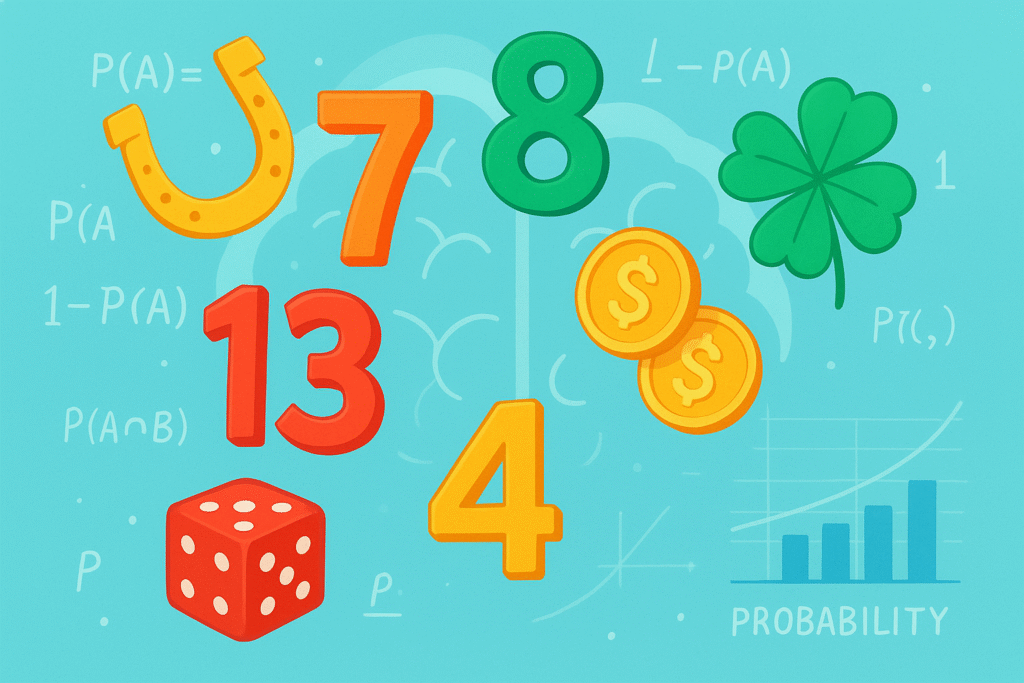
Maybe you avoid the number 13, feel excited when you see 777, or notice that your favorite sports player always wears number 7. You’re not alone—and you’re definitely not imagining things. The human fascination with lucky numbers spans every culture on Earth and has deep roots in both psychology and mathematics.
Welcome to the captivating world where superstition meets science, where ancient beliefs intersect with modern neuroscience, and where the numbers we consider “lucky” reveal fascinating truths about human nature itself.
The Psychology of Lucky Numbers: Why Our Brains Love Patterns
Before we dive into specific numbers, let’s understand why humans are so drawn to numerical superstitions in the first place. The answer lies deep within our psychology, shaped by millions of years of evolution. (Research on this at NCBI)
Pattern Recognition: The Foundation of Lucky Numbers
Our brains are essentially pattern-recognition machines. This ability helped our ancestors survive by identifying potential threats, finding food sources, and understanding seasonal changes. When it comes to numbers, this same pattern-seeking behavior creates what psychologists call “illusory correlation”—the tendency to see meaningful connections where none actually exist.
Consider this: when you notice that good things happen to you on dates containing the number 7, your brain files this away as potentially important information. Even though this connection is purely coincidental, your pattern-recognition system treats it as a meaningful discovery. This is why the psychology of luck is so closely tied to our cognitive biases.
The Availability Heuristic and Number Memory
Psychologist Daniel Kahneman’s research on cognitive biases reveals another crucial factor: the availability heuristic. We tend to judge the likelihood of events based on how easily we can remember similar occurrences. If you’ve had several positive experiences involving the number 8, those memories become more “available” to your conscious mind, making 8 feel luckier than other numbers.
This creates a self-reinforcing cycle. The more attention you pay to a particular number, the more likely you are to notice it—and the more meaningful it seems. It’s the same principle behind confirmation bias, where we unconsciously seek out information that supports our existing beliefs.
The Mathematics of Chance: When Numbers Actually Matter
While most number superstitions are psychological, mathematics does reveal some genuinely interesting patterns that might explain why certain numbers feel special.
The Law of Small Numbers
Mathematician Amos Tversky identified the “law of small numbers”—our tendency to draw conclusions from small sample sizes. If you flip a coin five times and get four heads, you might start thinking the coin is “lucky.” In reality, this outcome happens about 31% of the time with a fair coin, but our brains aren’t naturally equipped to understand probability this way.
This mathematical quirk helps explain why probability and statistics seem counterintuitive to most people. We’re biologically wired to spot patterns quickly, not to calculate precise probabilities. (See more research at Psychology Today)
Prime Numbers and Human Perception
Interestingly, many numbers considered lucky across cultures are prime numbers: 3, 7, 11, 13 (though 13 is considered unlucky in Western culture). Prime numbers have unique mathematical properties—they can only be divided by themselves and 1—which might make them feel more “special” or significant to our pattern-seeking minds.
Research by cognitive scientists suggests that our brains process prime numbers differently than composite numbers, potentially triggering the same neural pathways involved in recognizing unique or important information.
Cultural Perspectives: How History Shaped Lucky Numbers
Numbers don’t exist in a vacuum—they carry the weight of thousands of years of human history, religion, and cultural development. Understanding these cultural contexts reveals why the same number can be incredibly lucky in one society and deeply feared in another.
The Number 7: Universal Symbol of Fortune
Seven might be the closest thing we have to a universally lucky number. It appears in countless cultural and religious contexts (learn more about number superstitions at HowStuffWorks):
- Christianity: Seven days of creation, seven deadly sins, seven virtues
- Judaism: Seven branches of the menorah, seven-year cycles
- Islam: Seven heavens, seven verses in the opening chapter of the Quran
- Hinduism: Seven chakras, seven sacred rivers
- Ancient civilizations: Seven classical planets visible to the naked eye
Psychologically, seven also falls within our “magical number 7±2” range—the number of items most people can hold in their working memory simultaneously, as discovered by cognitive psychologist George Miller. This might explain why seven feels naturally comfortable and memorable to human minds.
The Number 8: East Asian Prosperity Symbol
In Chinese culture, the number 8 (八, bā) is considered extremely lucky because its pronunciation sounds similar to the word for wealth or prosperity (发, fā). This linguistic connection has created such strong cultural associations that:
- Phone numbers containing multiple 8s sell for thousands of dollars
- The 2008 Beijing Olympics began at 8:08 PM on August 8th (08/08/08)
- Real estate prices are higher for properties with addresses containing 8
- Many Chinese businesses incorporate 8 into their pricing strategies
This demonstrates how cultural beliefs can create real economic value and social behavior, even when based on linguistic coincidence rather than mathematical properties.
The Number 4: A Tale of Two Cultures
The number 4 provides a fascinating example of how cultural context completely transforms a number’s meaning. In many East Asian cultures (China, Japan, Korea), 4 is considered extremely unlucky because it sounds similar to the word for “death.” This has led to:
- Buildings skipping fourth floors (similar to how Western buildings avoid 13th floors)
- Hospital room numbers avoiding 4
- Product pricing strategies that avoid the number 4
However, in many Native American cultures, 4 is sacred and lucky, representing the four directions, four seasons, and four elements. This stark contrast illustrates how arbitrary—yet psychologically powerful—cultural number associations can be. (Learn more about cultural number fears at University of South Carolina)
The Neuroscience of Number Beliefs
Recent advances in neuroscience have begun to reveal what actually happens in our brains when we encounter “lucky” or “unlucky” numbers. These findings bridge the gap between superstition and science.
The Placebo Effect of Lucky Numbers
Research by psychologist Dr. Lysann Damisch at the University of Cologne found that believing in lucky symbols—including numbers—can actually improve performance. When participants believed they had a “lucky” ball while playing golf, they performed significantly better than those with a “normal” ball. (Read more about this at Live Science)
This suggests that lucky charms and beliefs work through a psychological mechanism similar to the placebo effect. The belief itself creates measurable changes in confidence, focus, and performance.
Neural Pattern Recognition and Numbers
Brain imaging studies show that when we see numbers we consider significant, our brains show increased activity in regions involved in attention and emotional processing (see research at NCBI). This neurological response might explain why lucky numbers can influence mood and decision-making.
Additionally, the brain’s reward system (involving dopamine release) activates more strongly when we encounter numbers we’ve previously associated with positive experiences. This creates a genuine neurochemical basis for why certain numbers can make us feel good. (Learn more at Medical News Today)
Modern Applications: Lucky Numbers in the Digital Age
Understanding the psychology and cultural significance of lucky numbers has practical applications in our modern world, from marketing strategies to personal well-being.
Marketing and Consumer Psychology
Companies worldwide leverage lucky number beliefs to influence consumer behavior:
- Pricing strategies: Using numbers like 8.88 in Chinese markets or avoiding 13 in Western contexts
- Product launches: Scheduling releases on dates containing culturally lucky numbers
- Brand development: Incorporating meaningful numbers into company names and logos
- Gaming industry: Using lucky numbers in slot machines and lottery systems
Personal Development and Positive Psychology
While we know lucky numbers aren’t magical, research suggests that positive beliefs and rituals can have measurable benefits for mental health and performance. This connects to broader research on how a positive mindset shapes fortune.
Some people use meaningful numbers as:
- Meditation focal points for mindfulness practices
- Personal reminders of important goals or values
- Confidence-building tools before important events
- Memory aids for important information
The Future of Number Psychology
As our understanding of cognitive science advances, we’re discovering new layers to the psychology of numbers. Emerging research areas include:
Artificial Intelligence and Number Preferences
AI systems trained on human data are beginning to show patterns that mirror our number preferences, raising interesting questions about whether numerical biases are fundamental to information processing or purely cultural. (Research findings at ScienceDirect)
Cross-Cultural Psychological Research
Global connectivity is allowing researchers to study how different cultural number beliefs interact and evolve. Some studies suggest that exposure to multiple cultures can reduce the strength of number superstitions, while others find that it creates more complex, layered beliefs. (Current research trends at ScienceDaily)
Conclusion: Numbers, Meaning, and Human Nature
The science behind lucky numbers reveals something beautiful about human nature: we are meaning-making creatures. Whether rooted in ancient religious traditions, linguistic coincidences, or psychological patterns, our relationships with numbers reflect our deep need to find significance and control in an uncertain world.
While mathematics tells us that all numbers have equal probability in truly random events, psychology and culture show us that numbers are never just numbers—they’re symbols carrying thousands of years of human experience, hope, and belief.
Understanding the science behind lucky numbers doesn’t diminish their power; it reveals how remarkable our human capacity for creating meaning truly is. Whether you see 11:11 on a clock and make a wish, choose 7 as your lottery number, or avoid 13th floors, you’re participating in one of humanity’s oldest traditions: the search for patterns, meaning, and perhaps just a little bit of luck.
The next time you encounter your lucky number, remember that while the universe might not be keeping score, your brain certainly is—and sometimes, that’s all the magic we need.
Ready to test your luck with something more than just numbers? Try the Lucky Button and discover what delightful surprises await!
🌐 Additional External Resources:
- Medical News Today: The Psychology of Superstition
- HowStuffWorks: 13 Superstitions About Lucky Numbers and Unlucky Numbers
- Live Science: Superstitions Bring Real Luck, Study Reveals
- University of South Carolina: Why is 13 considered unlucky?
- Psychology Today: Why the Human Brain Is So Good at Detecting Patterns
- ScienceDirect: Lucky issuance: The role of numerological superstitions in irrational return premiums
- ScienceDirect: Measuring superstitious belief: why lucky charms matter
- ScienceDirect: “Lucky” numbers, unlucky consumers
- Wikipedia: Pattern Recognition (Psychology)
- NCBI: Superior pattern processing is the essence of the evolved human brain
- ScienceDaily: This is your brain detecting patterns
- Wikipedia: Numerical Cognition
🔗 Related Articles on Lucky Button:
📚 Research References:
- Damisch, L., Stoberock, B., & Mussweiler, T. (2010). “Keep your fingers crossed! How superstition improves performance.” Psychological Science, 21(7), 1014-1020.
- Kahneman, D. (2011). Thinking, Fast and Slow. Farrar, Straus and Giroux.
- Konovalov, A., & Krajbich, I. (2018). “Neurocomputational Dynamics of Sequence Learning.” Neuron, 99(6), 1205-1220.
- Miller, G. A. (1956). “The magical number seven, plus or minus two: Some limits on our capacity for processing information.” Psychological Review, 63(2), 81-97.
- Tversky, A., & Kahneman, D. (1971). “Belief in the law of small numbers.” Psychological Bulletin, 76(2), 105-110.
- Wiseman, R. (2003). The Luck Factor: The Scientific Study of the Lucky Mind. Arrow Books.
- Kurzweil, R. (2012). How to Create a Mind: The Secret of Human Thought Revealed. Penguin Books.
- Mattson, M. P. (2014). “Superior pattern processing is the essence of the evolved human brain.” Frontiers in Neuroscience, 8, 265.
🔗 Experience The Lucky Button
Try our original Lucky Button tool—a simple daily reminder to pause, breathe, and invite positive energy into your day.
Your Next Lucky Break Starts Here
Try this:
 The Money Script – Reprogram Your Financial Luck** Manifestation Magic – Attract What You Focus On
These tools pair perfectly with your own beliefs — empowering you to turn symbolic energy into real-world results.