Table of Contents
- The “Rule of Three” Isn’t Actually a Rule
- Why Your Brain Loves Patterns (Even Fake Ones)
- The Science Behind Bad Luck Streaks
- Why We Focus on Bad Things More Than Good Ones
- Real Examples of How This Tricks Us
- How to Break Free from Bad Luck Thinking
- Why Some Days Really Do Feel Unluckier
- What This Means for Your Daily Life
- The Connection to Other Lucky Beliefs
- Breaking Free from Superstitious Thinking
- Your Brain on Luck: The Takeaway
->
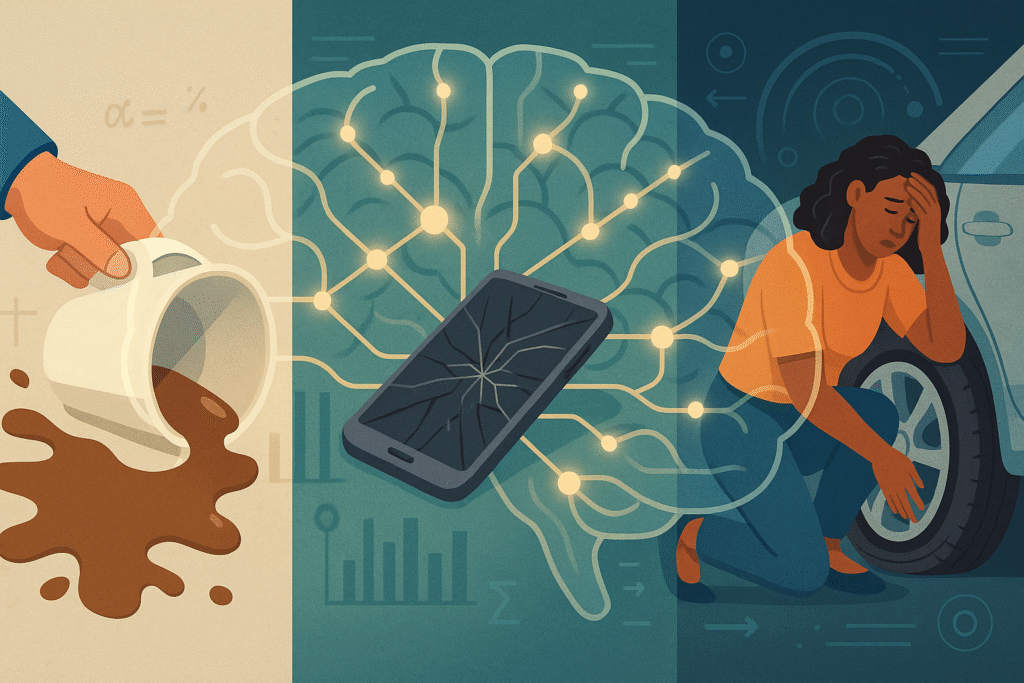
This happens to everyone. We notice when bad things seem to pile up, and we expect them to come in groups of three. But here’s what scientists have discovered: bad luck doesn’t actually cluster in threes. Your brain just makes it seem that way.
Understanding why this happens can help you feel less anxious when things go wrong. And it might even help you break out of those frustrating streaks when everything seems to go sideways.
The “Rule of Three” Isn’t Actually a Rule
Let’s start with some good news: there’s no cosmic force making bad things happen in groups of three. No universal law says your day has to get worse after two bad things happen.
Myth vs Reality
The Myth: Bad things naturally happen in threes because of fate, karma, or mysterious forces
The Reality: Your brain is really good at finding patterns, even when they don’t exist
Think about it this way: stuff happens to you all day long. Some good, some bad, some just neutral. But your brain doesn’t pay equal attention to everything. It focuses on the dramatic stuff, especially the bad stuff, because that’s how we survived as a species.
When something bad happens, your brain goes on high alert. It starts looking for more problems. And guess what? It usually finds them, because small annoying things happen all the time. We just don’t usually notice them.
Why Your Brain Loves Patterns (Even Fake Ones)
Your brain is basically a pattern-finding machine. This was super useful when humans lived in caves and needed to spot danger quickly. If you heard a rustling bush, it was better to assume it was a tiger than ignore it and become lunch.
How Your Brain Creates Patterns
Pattern Recognition: Your brain looks for connections between events, even random ones
Confirmation Bias: Once you expect bad things to happen in threes, you start noticing every time it seems true
Memory Selection: You remember the times when bad things clustered but forget all the times they didn’t
The number three is special to humans for lots of reasons. It shows up everywhere in our culture: fairy tales (three bears, three pigs), religion (the Trinity), and storytelling (beginning, middle, end). Our brains are trained to think in threes.
So when bad things happen, three feels like a complete set. It has a satisfying sense of closure. Two bad things feels unfinished, like you’re waiting for the other shoe to drop. Four feels like too many to keep track of easily.
The Science Behind Bad Luck Streaks
Researchers have studied this phenomenon, and here’s what they found: random events naturally cluster sometimes. It’s actually weird if they don’t.
What Studies Show
Scientists at Harvard looked at thousands of “unlucky streaks” and found that they happen exactly as often as you’d expect from pure chance. There’s no mysterious force making bad things cluster.
But people remember the clusters and forget all the single bad events that happened alone. This makes clusters seem much more common than they really are.
Here’s a simple way to think about it: flip a coin 100 times. You’ll get some runs where heads comes up several times in a row. That’s not the coin being “unlucky” or “stuck.” That’s just how randomness works.
The same thing happens with daily life events. Sometimes several annoying things happen close together. Sometimes they’re spread out. Both patterns are totally normal.
Why We Focus on Bad Things More Than Good Ones
There’s another reason the “bad things in threes” belief feels so real: we pay way more attention to negative events than positive ones.
The Negativity Bias
Your brain gives about five times more weight to bad experiences than good ones. This helped our ancestors stay alive, but it makes modern life feel more negative than it really is.
When you spill coffee, your brain treats it as important information. When you successfully drink coffee without spilling it (which happens way more often), your brain basically ignores it.
This means you’re constantly collecting examples of bad things happening, but you’re not keeping track of all the times when bad things didn’t happen, or when good things happened instead.
It’s like having a photo album where you only keep pictures of rainy days. After a while, you’d think it rains all the time, even though sunny days are more common.
Real Examples of How This Tricks Us
Common “Bad Luck in Threes” Stories
The Morning Rush: Wake up late, can’t find keys, hit traffic. (But you forget about the hundreds of smooth mornings)
Technology Troubles: Phone dies, computer crashes, Wi-Fi goes down. (But ignore all the days when tech works fine)
Social Situations: Awkward conversation, spill food, trip slightly. (But don’t count successful social interactions)
Here’s what’s really happening in these situations: you’re having a normal day with a random mix of good and bad events. But once the first bad thing happens, your brain starts paying extra attention. Suddenly, you notice every small problem that you’d normally ignore.
That slight stumble? On a good day, you wouldn’t even remember it. But when you’re already feeling unlucky, it becomes “the third bad thing” in your story.
How to Break Free from Bad Luck Thinking
Understanding how your brain works is the first step to feeling less stressed when things go wrong. Here are some practical ways to change your perspective:
Keep a More Balanced Mental Record
Start noticing neutral and good things that happen during your day. Most events are actually pretty neutral, but we don’t pay attention to them.
For example: you probably turned on lights that worked, used doors that opened properly, and walked on sidewalks that didn’t have holes in them. These things went right, but your brain treated them as non-events.
Question the Pattern
When you catch yourself thinking “bad things happen in threes,” ask yourself: is this really a pattern, or am I just looking for one?
Try counting different ways. Maybe good things happened in twos that day. Maybe neutral things happened in fours. Once you start looking for other patterns, the “rule of three” stops seeming so special.
The “So What?” Test
When something bad happens, ask yourself: “So what? Will this matter next week?” Most of the time, the answer is no. This helps your brain put things in perspective and reduces the drama around small problems.
Focus on What You Can Control
Instead of waiting for the “third bad thing” to happen, focus on what you can actually influence. Can you slow down to avoid mistakes? Can you double-check things? Can you take a different route?
This connects to research on how mindset affects what we perceive as lucky or unlucky. When you feel more in control, you’re less likely to see random events as part of an unlucky pattern.
Test Your Pattern Recognition
How good are you at spotting real patterns versus imaginary ones? Take our quiz to see how your brain handles randomness and probability!
Why Some Days Really Do Feel Unluckier
Now, let’s be fair: some days genuinely are worse than others. But it’s usually not because of mysterious bad luck forces. Here are the real reasons some days feel cursed:
The Snowball Effect
Sometimes one bad thing actually does cause another. You wake up late, so you rush, so you spill coffee, so you’re stressed, so you make more mistakes. This isn’t cosmic bad luck; it’s just cause and effect.
Your Mental State Affects Everything
When you’re tired, stressed, or distracted, you’re more likely to make small mistakes. And when you’re already feeling unlucky, you interpret neutral events as negative ones.
It’s like wearing gray-tinted glasses. Everything looks darker, but the problem is with your glasses, not with the world.
Monday Morning Syndrome
Some times of day or week are naturally more stressful. Monday mornings, Friday afternoons, or the hour before an important meeting. More stress means more mistakes, which can feel like bad luck but is really just poor timing.
What This Means for Your Daily Life
Understanding the psychology behind “bad luck comes in threes” can actually make your life better in practical ways:
Practical Benefits
Less Anxiety: You won’t spend your day waiting for the third bad thing to happen
Better Perspective: Small problems won’t feel like part of a larger pattern
More Control: You’ll focus on preventing real problems instead of worrying about imaginary ones
Improved Mood: You’ll notice more of the good and neutral things that happen every day
This doesn’t mean you should ignore your intuition or stop paying attention to warning signs. It just means you don’t have to live in fear of mysterious bad luck patterns.
When something bad happens, deal with it and move on. Don’t spend mental energy wondering what the next two problems will be.
The Connection to Other Lucky Beliefs
The “bad things in threes” belief is related to lots of other ideas about luck and patterns. Understanding one helps you understand them all.
For example, this same pattern-seeking behavior explains why people believe in lucky charms or think certain numbers are special. Our brains are always looking for connections, even when events are actually random.
Learning about how probability really works can help you see through these illusions and feel more in control of your life.
“The human brain is exceptional at finding patterns. Unfortunately, it’s also exceptional at finding patterns that aren’t there.”
— Dr. Michael Shermer, psychologist
Breaking Free from Superstitious Thinking
Here’s the bottom line: you don’t have to live your life according to superstitious rules that aren’t even real.
Bad things don’t happen in threes any more than good things happen in fours or neutral things happen in sevens. Stuff just happens, randomly, throughout your day.
When you stop looking for these patterns, you’ll probably notice that life feels less stressful and more manageable. You’ll spend less time worrying about what might go wrong and more time dealing with what actually does go wrong.
And here’s the really good news: if bad things don’t actually cluster in threes, then you don’t have to wait for two more problems when one bad thing happens. You can just deal with the one problem and move on with your day.
Your Brain on Luck: The Takeaway
The next time someone tells you that bad things happen in threes, you can smile and share what you’ve learned: it’s not cosmic forces at work, it’s just your pattern-loving brain doing what it evolved to do.
Your brain is trying to help you by looking for threats and patterns. But in modern life, this ancient survival tool sometimes creates more anxiety than protection.
The good news is that once you understand how it works, you can appreciate your brain’s pattern-finding abilities without being controlled by them. You can notice when you’re looking for problems that aren’t really there and redirect your attention to things that actually matter.
And remember: for every story about bad things happening in threes, there are probably dozens of times when bad things happened alone, in pairs, or not at all. You just didn’t notice those times because your brain wasn’t keeping score.
Ready to see how your own brain handles patterns and probability? Try our Lucky Button and notice whether you start looking for patterns in the results. It’s a fun way to catch your pattern-seeking mind in action!
External Resources & Links:
- Psychology Today: Understanding Pattern Recognition
- NCBI: Cognitive Biases in Human Thinking
- Scientific American: Why We See Patterns That Aren’t There
- American Psychological Association: The Psychology of Superstitions
- Psychophysiological reactions to news
- Nature: Randomness and Pattern Recognition in Human Behavior
Related Articles on Lucky Button:
Tags:
Bad Luck
Pattern Recognition
Cognitive Bias
Psychology
Superstition
Confirmation Bias
Negativity Bias
Random Events
Brain Science
Probability
Myths
Behavioral Science
Experience The Lucky Button
Ready to experience how simple rituals can shift your mindset, just like they have for thousands of years? Try our original Lucky Button tool and connect with the same human psychology that created historical superstitions.