Table of Contents
- Ancient Origins: Where Modern Superstitions Begin
- Medieval Evolution: How Religious Doctrine Shaped Beliefs
- Common Superstitions Analyzed: The Stories Behind the Beliefs
- Cultural Transmission: How Superstitions Spread and Survive
- The Psychology of Persistence: Why Ancient Beliefs Endure
- Modern Manifestations: Historical Beliefs in Contemporary Life
- Cross-Cultural Analysis: Global Variations on Universal Themes
- The Scientific Perspective: Separating Fact from Fiction
- Conclusion: Living with Historical Echoes
When you automatically say “bless you” after someone sneezes, avoid walking under ladders, or feel a slight unease when a black cat crosses your path, you’re participating in a conversation that began thousands of years ago. These seemingly innocuous behaviors connect us directly to our ancestors’ deepest fears, practical wisdom, and spiritual beliefs.
Modern superstitions aren’t random cultural artifacts—they’re historical treasures, each carrying stories of ancient civilizations, medieval religious doctrine, and the timeless human struggle to understand and control an unpredictable world. Understanding their origins reveals not just fascinating history, but profound insights into how human cultures develop, transmit, and preserve knowledge across millennia.
Ancient Origins: Where Modern Superstitions Begin
The roots of contemporary superstitions stretch back to humanity’s earliest civilizations, where the line between practical knowledge, religious belief, and protective magic was virtually nonexistent. Ancient Egyptian religious practices established many patterns that would influence Western superstitions for thousands of years.
Ancient Civilizations and Their Lasting Superstitions
Ancient Egypt (3100-30 BCE)
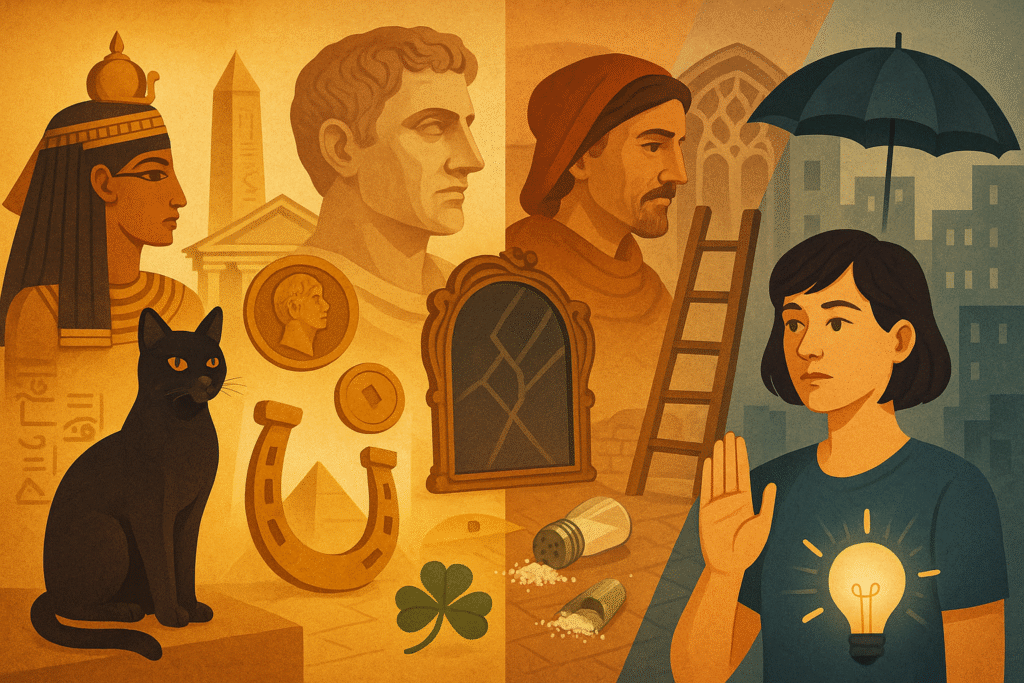
Black Cats as Sacred Protectors: Cats were revered as sacred animals, associated with the goddess Bastet. Killing a cat was punishable by death. This reverence would later invert in medieval Europe, creating the modern superstition of black cats as omens.
Mirror Magic: Polished metal mirrors were believed to show the soul’s reflection. Breaking one was thought to damage the soul itself, establishing the foundation for the “seven years bad luck” belief.
Ancient Greece (800-146 BCE)
Salt’s Sacred Value: Salt was so precious it was used in religious ceremonies and as currency. Spilling salt wasted something sacred and valuable, establishing protective rituals that persist today.
Number Symbolism: Pythagorean mathematics assigned mystical properties to numbers, creating numerical superstitions that influence everything from building floor numbering to lottery ticket purchases.
Ancient Rome (753 BCE-476 CE)
Threshold Protection: Roman homes had protective spirits (Lares) guarding doorways. Proper entry rituals prevented spiritual contamination—the origin of “knock on wood” and stepping stone superstitions.
Augury and Omens: Professional priests interpreted bird flight patterns, animal behavior, and natural phenomena to predict future events, establishing pattern-seeking behaviors that persist in modern superstitions.
The Practical Wisdom Hidden in Ancient Superstitions
Many ancient superstitions encoded practical knowledge crucial for survival. Folklore research reveals how these beliefs served as mnemonic devices, preserving important information across generations when literacy was rare.
For example, the Roman practice of throwing spilled salt over the left shoulder wasn’t mere ritual—salt was genuinely valuable, and the gesture reminded people to be careful with precious resources. Similarly, elaborate hand-washing rituals disguised as spiritual purification actually provided effective disease prevention in pre-scientific societies.
Medieval Evolution: How Religious Doctrine Shaped Beliefs
The medieval period (roughly 500-1500 CE) transformed many ancient superstitions through the lens of Christian theology. Medieval belief systems created powerful new superstitions while adapting existing ones to fit Christian cosmology.
The Demonization of Ancient Symbols
Medieval Christian doctrine systematically reinterpreted pagan symbols and practices, often inverting their meanings. This process created many superstitions we recognize today:
Black Cats: From Sacred to Sinister
Ancient Status: Egyptian cats were sacred, Roman cats brought good fortune
Medieval Transformation: Association with witchcraft and devil worship during the witch trials (1400s-1600s)
Modern Legacy: Black cats still face adoption challenges in animal shelters due to persistent negative associations
The transformation wasn’t arbitrary—it served specific social and religious functions. By associating traditional practices with evil, church authorities could more effectively convert pagan populations to Christianity. This systematic rebranding created superstitions that were both familiar enough to feel natural and threatening enough to motivate compliance.
Medieval Medical Knowledge Disguised as Superstition
Many medieval superstitions preserved important medical knowledge. The practice of saying “God bless you” after sneezing originated from the bubonic plague pandemic (1347-1351), when sneezing was an early symptom of the deadly disease. Historical epidemiology research shows how superstitions often encoded public health measures.
Similarly, many food-related superstitions emerged from practical preservation knowledge. Avoiding certain combinations or preparation methods—disguised as spiritual prohibitions—actually prevented food poisoning and nutritional deficiencies in pre-refrigeration societies.
Common Superstitions Analyzed: The Stories Behind the Beliefs
Understanding specific superstitions reveals the complex interplay of practical knowledge, religious doctrine, and psychological comfort that created our modern belief landscape.
Breaking Mirrors: Seven Years of Psychological Insight
The broken mirror superstition demonstrates how ancient beliefs adapt to new technologies while preserving their core psychological functions:
Historical Evolution of Mirror Superstitions
Ancient Greece: Catoptromancy (divination using mirrors) connected reflections to souls and futures
Roman Era: Seven-year cycle based on Roman belief that bodies completely renew every seven years
Medieval Period: Mirrors became associated with vanity and devil worship
Modern Psychology: The superstition provides a framework for processing bad luck and maintaining control beliefs
The “seven years” specification isn’t random—it reflects ancient understanding of human biological cycles and provides a specific timeframe that makes the consequence feel manageable rather than eternal.
Walking Under Ladders: Architecture Meets Spirituality
This superstition combines practical safety advice with profound religious symbolism. Ladders leaning against walls form triangles, which medieval Christians interpreted as representations of the Holy Trinity. Walking through the triangle was seen as violating sacred space.
The practical element is equally important—construction accidents involving ladders were common, making avoidance a sensible safety measure. The superstition preserved this wisdom in memorable, emotionally resonant form.
Spilling Salt: Economics Encoded as Spirituality
Historical anthropology research reveals that salt superstitions encoded complex economic and social information:
- Economic Value: Salt was so valuable it was used as currency (hence “salary”)
- Preservation Knowledge: Proper salt handling prevented food spoilage
- Social Signaling: How someone handled salt indicated their social status and education
- Trade Relationships: Salt rituals reinforced important commercial partnerships
The left shoulder throwing ritual specifically addresses the belief that demons lurked over the left shoulder, requiring protection through salt’s purifying properties. This created a memorable response that prevented waste while maintaining spiritual protection.
Cultural Transmission: How Superstitions Spread and Survive
The persistence of historical superstitions reveals sophisticated mechanisms of cultural transmission that operate largely below conscious awareness. Cultural evolution research shows how beliefs spread and adapt across generations through multiple transmission pathways.
Family and Community Networks
Most superstitions transfer through intimate social networks where emotional significance enhances memorability. Children learn these beliefs through observation and imitation, often without explicit instruction. This informal transmission creates deep emotional associations that resist logical analysis in adulthood.
European-American Transmission
Primary Method: Family traditions and community practice
Key Beliefs: Black cats, broken mirrors, ladder avoidance
Evolution: Adaptation to urban environments and modern technology
African-American Transmission
Primary Method: Oral tradition and community wisdom
Key Beliefs: Protective rituals, ancestor communication, herbal knowledge
Evolution: Integration with European superstitions during colonial period
Indigenous American Transmission
Primary Method: Ceremonial practice and seasonal cycles
Key Beliefs: Animal omens, natural phenomena interpretation, sacred geography
Evolution: Resistance to external influence while adapting to modern contexts
Media and Popular Culture Amplification
Modern media has dramatically accelerated superstition transmission while sometimes distorting original meanings. Movies, television, and social media can spread beliefs rapidly across cultural boundaries, but often strip away historical context that gave them meaning.
This creates interesting hybrid superstitions—beliefs that combine elements from different cultures and time periods, adapted for contemporary audiences. Halloween traditions exemplify this process, mixing Celtic, Roman, Christian, and American commercial elements into new synthetic beliefs.
The Psychology of Persistence: Why Ancient Beliefs Endure
The durability of historical superstitions reveals fundamental aspects of human psychology that remain constant despite technological and social changes. Psychological research on superstitious behavior identifies several mechanisms that maintain these beliefs across centuries.
Cognitive Biases and Pattern Recognition
Human brains are evolutionary designed to detect patterns and assign causation, even when none exists. This tendency, while crucial for survival, also makes us susceptible to superstitious thinking. Historical superstitions exploit these cognitive biases by providing simple cause-and-effect explanations for complex phenomena.
The availability heuristic makes dramatic historical stories more memorable than statistical probabilities. We remember tales of cursed mirrors and witch-associated cats more easily than probability calculations, making superstitions feel more “real” than scientific explanations.
Anxiety Management and Control
Superstitions provide psychological comfort by creating illusions of control over uncertain outcomes. This function explains their persistence during stressful periods—wars, plagues, economic downturns, and personal crises all increase superstitious behavior as people seek any available source of perceived control.
Historical superstitions are particularly effective because they carry the weight of ancestral wisdom. Following practices that “kept our ancestors safe” provides emotional reassurance even when logical analysis reveals their ineffectiveness.
Test Your Historical Knowledge
How well do you understand the origins and evolution of common superstitions? Take our interactive quiz to discover the fascinating history behind everyday beliefs!
Social Bonding and Group Identity
Shared superstitions create group cohesion by establishing common practices and beliefs. When group members follow the same protective rituals or avoid the same taboos, they reinforce social bonds and group identity. This function explains why superstitions often intensify during periods of social threat or change.
Historical superstitions are particularly powerful for this purpose because they connect current group members to ancestors, creating a sense of continuity and tradition that strengthens group identity across generations.
Modern Manifestations: Historical Beliefs in Contemporary Life
Despite living in an age of scientific explanation, historical superstitions continue to influence contemporary behavior in surprising ways. Modern behavioral research reveals how ancient beliefs adapt to contemporary contexts while maintaining their essential functions.
Architecture and Urban Planning
Many modern buildings skip the 13th floor, reflecting medieval Christian associations between 13 and misfortune (related to the Last Supper and crucifixion). This practice demonstrates how historical superstitions influence contemporary design decisions worth billions of dollars in real estate value.
Similarly, feng shui principles in modern architecture combine ancient Chinese beliefs about energy flow with contemporary design aesthetics, creating spaces that feel psychologically comfortable while honoring traditional wisdom.
Digital Age Adaptations
Historical superstitions have adapted remarkably well to digital environments. People avoid certain usernames, email addresses, or phone numbers that contain “unlucky” digit combinations. Social media has created new transmission pathways for ancient beliefs, allowing rapid spread while often losing historical context.
The psychology behind historical superstitions—pattern recognition, anxiety management, and social bonding—operates equally well in digital environments, explaining their continued relevance in contemporary life.
Consumer Behavior and Marketing
Businesses worldwide adapt marketing strategies to accommodate historical superstitions. Airlines avoid row 13, hotels skip floor 13, and product launches avoid dates considered unlucky in target markets. This demonstrates the continued economic impact of beliefs that originated thousands of years ago.
Understanding superstition psychology also enables more effective marketing. Products positioned as “lucky” or protective tap into the same psychological needs that sustained historical beliefs, creating emotional connections that influence purchasing decisions.
Cross-Cultural Analysis: Global Variations on Universal Themes
While specific superstitions vary dramatically across cultures, underlying themes remain remarkably consistent. Cross-cultural anthropological research reveals universal human concerns expressed through culturally specific symbolic systems.
Universal Themes in Historical Superstitions
- Protection from Harm: Every culture develops beliefs about warding off danger, evil spirits, or bad luck
- Prosperity and Abundance: Rituals for ensuring good harvests, successful hunts, or business success
- Health and Healing: Practices for preventing illness, promoting recovery, or ensuring fertility
- Death and Afterlife: Beliefs about proper treatment of the deceased and communication with ancestors
- Social Harmony: Taboos and rituals that reinforce community cooperation and resolve conflicts
Cultural Adaptations of Common Superstitions
The same psychological needs produce different cultural expressions based on local history, environment, and social structures:
East Asian Variations
Number Beliefs: 4 is unlucky (sounds like “death”), 8 is fortunate (sounds like “prosperity”)
Mirror Practices: Mirrors deflect negative energy when properly positioned according to feng shui principles
Animal Symbolism: Cats are generally fortunate, dragons bring luck and protection
Middle Eastern Traditions
Evil Eye Protection: Blue beads and hand symbols ward off malevolent gazes
Salt Ceremonies: Salt circles provide spiritual protection and purification
Threshold Rituals: Specific prayers and actions required when entering sacred or important spaces
Latin American Practices
Day of the Dead: Ancestor communication through specific ritual practices
Protective Saints: Patron saints for specific activities, locations, and life challenges
Herbal Traditions: Plant-based protection and healing practices with indigenous roots
The Scientific Perspective: Separating Fact from Fiction
Modern scientific understanding allows us to evaluate historical superstitions objectively while appreciating their cultural and psychological functions. Evolutionary psychology research explains why humans developed superstitious thinking and how these cognitive patterns persist despite contradicting scientific evidence.
When Historical Superstitions Contain Scientific Truth
Some historical superstitions encode accurate scientific observations that were later validated through formal research:
- Herbal Medicine: Many traditional plant remedies contain active compounds now used in pharmaceuticals
- Hygiene Practices: Ritual purification often involved effective disease prevention measures
- Food Safety: Religious dietary restrictions frequently prevented foodborne illnesses
- Social Psychology: Community bonding rituals enhanced group survival and cooperation
Distinguishing Correlation from Causation
Scientific analysis reveals that many superstitions work through psychological rather than supernatural mechanisms. The placebo effect, confirmation bias, and behavioral changes can create real improvements in outcomes even when the underlying beliefs are factually incorrect.
This understanding connects to research on how psychological factors influence luck perception and demonstrates why historical superstitions can feel effective even when they lack supernatural power.
The Value of Historical Superstitions in Modern Context
Rather than dismissing historical superstitions as primitive ignorance, scientific analysis reveals their sophisticated functions in human societies. They serve as:
- Anxiety Management Tools: Providing psychological comfort during uncertain times
- Social Coordination Mechanisms: Creating shared practices that strengthen group bonds
- Cultural Memory Systems: Preserving important historical knowledge across generations
- Decision-Making Frameworks: Offering simple rules for navigating complex situations
Conclusion: Living with Historical Echoes
Historical superstitions represent one of humanity’s most enduring cultural achievements—belief systems that have successfully transmitted across thousands of years while adapting to radically different social, technological, and intellectual environments. Understanding their origins and evolution reveals not just fascinating history, but profound insights into human psychology and cultural development.
These ancient beliefs persist because they address fundamental human needs that remain constant despite technological progress: the need for control over uncertain outcomes, connection to cultural tradition, and psychological comfort during difficult times. Rather than viewing superstitions as obstacles to rational thinking, we can appreciate them as sophisticated psychological and social tools that served our ancestors well and continue to provide value in contemporary contexts.
The key insight from studying historical superstitions is recognizing the difference between their instrumental value (what they accomplish psychologically and socially) and their literal truth claims (whether they accurately describe physical reality). This distinction allows us to appreciate their cultural significance while maintaining scientific reasoning about causation and probability.
When you next find yourself automatically avoiding a black cat or throwing salt over your shoulder, remember that you’re participating in a conversation that began in ancient temples and medieval cathedrals. These simple actions connect you to thousands of ancestors who faced uncertainty with the same human need for meaning, control, and hope that defines our species.
The historical superstitions that influence us today represent humanity at its most creative and resilient—finding ways to transform anxiety into action, uncertainty into ritual, and isolation into community through the power of shared belief and common practice.
Understanding this heritage doesn’t require believing in supernatural causation, but it does invite appreciation for the remarkable ways human cultures develop, preserve, and transmit wisdom across generations. In our fast-paced modern world, these ancient voices remind us that some human experiences transcend historical periods and technological changes.
Ready to explore how ancient beliefs connect to modern psychology? Try our Lucky Button and experience firsthand how simple rituals can shift mental states and create positive expectations—just as they have for our ancestors throughout history.
🌐 Academic Resources & External Links:
- Oxford Academic: The Origins of Superstition – A Very Short Introduction
- Encyclopedia Britannica: Superstition – Description & Examples
- PMC (PubMed Central): The Evolution of Superstitious and Superstition-like Behaviour
- British Museum: Ancient Origins of Modern Superstition
- Google Arts & Culture: 18 Superstitions from Around the World
- Ancient Origins: 10 Spine-Chilling Ancient Superstitions and Their Origins
- History Collection: The Origins of 10 Ancient Superstitions We Still Follow Today
- Medical News Today: The Psychology of Superstition
- British Psychological Society: The Everyday Magic of Superstition
- Psychology Today: Superstition – The Good, the Bad and the Ugly
- Superstition Library: The Global Encyclopedia of Superstitions
- Wikipedia: Superstition – Comprehensive Overview
Related Articles on Lucky Button:
- The Psychology of Luck: Why Some People Feel Luckier Than Others
- Lucky Charms: The Science Behind Belief and Performance
- Lucky Numbers Across Cultures: Why 7 and 13 Matter
- Probability & Statistics: The Math Behind Luck
- Mind Over Luck: How a Positive Mindset Can Shape Your Fortune
- Lucky Accidents That Changed the World
Academic References:
- Frazer, J. G. (1890). The Golden Bough: A Study in Comparative Religion. Macmillan.
- Thomas, K. (1971). Religion and the Decline of Magic. Scribner.
- Boyer, P. (2001). Religion Explained: The Evolutionary Origins of Religious Thought. Basic Books.
- Henrich, J. (2015). The Secret of Our Success: How Culture Is Driving Human Evolution. Princeton University Press.
- Tylor, E. B. (1871). Primitive Culture: Researches into the Development of Mythology, Philosophy, Religion, Art, and Custom. John Murray.
- Evans-Pritchard, E. E. (1937). Witchcraft, Oracles and Magic among the Azande. Oxford University Press.
- Douglas, M. (1966). Purity and Danger: An Analysis of Concepts of Pollution and Taboo. Routledge.
- Lévi-Strauss, C. (1962). The Savage Mind. University of Chicago Press.
- Ginzburg, C. (1991). Ecstasies: Deciphering the Witches’ Sabbath. University of Chicago Press.
- Briggs, R. (2002). Witches and Neighbors: The Social and Cultural Context of European Witchcraft. Penguin Books.
Experience The Lucky Button
Ready to experience how simple rituals can shift your mindset, just like they have for thousands of years? Try our original Lucky Button tool and connect with the same human psychology that created historical superstitions.